June 8, 2026
What is a Tractor Ridger in Farming? Uses, Benefits, and How It Works
Whether you’re building up potato beds or cutting channels through a sugarcane field, a ridger ends up doing a lot of the heavy lifting even if most farmers don’t think about it that way.
Still, a lot of farmers, especially those picking up their first tractor implement aren’t fully clear on what a ridger actually does, which crops call for it, or how to pick the right one.
This guide walks through all of it, what a ridger is, how it works, where farmers actually use it, and what to look for before buying one.
What is a Tractor Ridger?
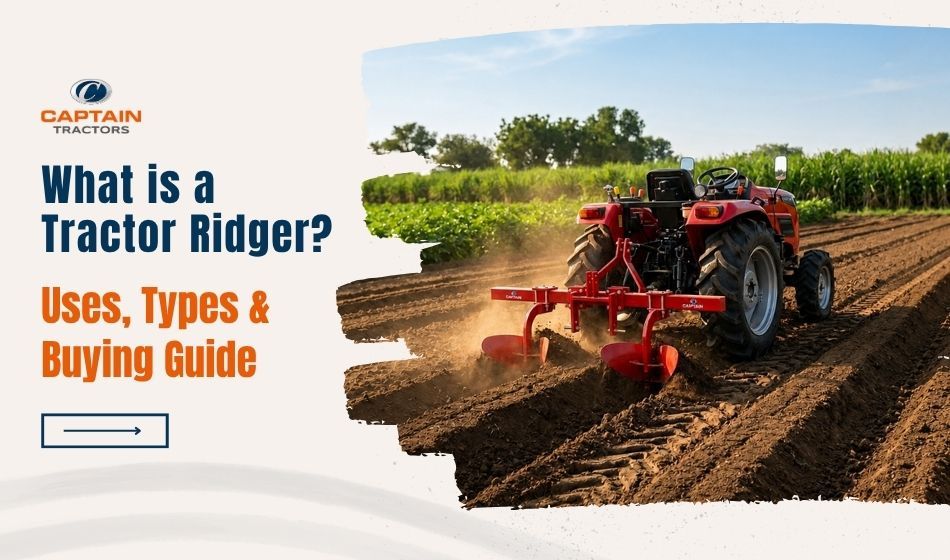
A tractor ridger is a soil-working implement attached to the rear three-point linkage of a tractor. It cuts into the soil and throws it to either side, building up raised ridges and furrows in one pass.
The raised portion is called a ridge, this is where seeds or seedlings are planted. The lower channel between two ridges is called a furrow, this is where water flows and drains.
Ridging itself has been around for generations, but running a tractor-mounted ridger through a field gets the job done in far less time, with better consistency, and without the back-breaking labour of doing it by hand or with animals.
A plough breaks and turns the soil, that’s its job. A ridger does something different: it shapes the already-loosened soil into rows. That row structure is what crops needing raised beds, drainage, or defined spacing actually depend on.
How a Tractor Ridger Works
A tractor ridger mounts directly onto the tractor’s three-point hydraulic linkage at the rear, no separate attachment system needed.
When the tractor moves forward across the field:
The ridger’s body, also called the share or bottom, bites into the soil and wedges it apart. Two wing-shaped mouldboards, one on each side, push that loosened soil outward and upward, leaving a raised ridge sitting between two furrows.
With each parallel pass across the field, another set of uniform ridges and furrows gets laid down until the whole plot is done.
Ridge depth is managed through the tractor’s hydraulic system. The operator adjusts the implement up or down until the ridge height suits whatever crop is going in.
On Indian farms, you’ll find ridgers that are either PTO-driven or simply draft-pulled through the three-point linkage; it depends on the specific model.
Main Uses of a Tractor Ridger
1. Potato Farming
Potato farming probably sees more ridger use than anything else. The tubers need to develop underground, away from light and standing water and a raised bed is what makes that possible.
Once seed potatoes are in the ground, the ridger gets brought back to mound soil up around the base of each plant, a job called earthing up. Most farmers do this at least once, sometimes twice, across the season.
A good ridge keeps tubers buried and protected, pulls water away from the root zone, and groups the potatoes into a clear row that’s much easier to harvest.
For farmers growing potatoes alongside a Potato Planter or Potato Digger, a ridger rounds out the full set of potato farming implements.
2. Sugarcane Farming
Sugarcane is planted in furrows, not on ridges. So the ridger is used first to create deep furrows where the sugarcane cane pieces (setts) are placed.
After planting, the ridger goes back between the rows to cut channels for irrigation water and keep the root zone from sitting in water. Managing water properly over a long sugarcane cycle is difficult without this.
3. Vegetable Farming
Tomatoes, brinjal, capsicum, cabbage, onions, cauliflower, most of these do noticeably better on raised beds. Keeping the root zone up off the flat soil helps with air circulation and stops water from pooling around the roots, which shows up in healthier plants and better yield.
Ridgers allow vegetable farmers to create uniform planting rows quickly. Row spacing can be adjusted by controlling the passes of the tractor.
4. Cotton Farming
Cotton is typically grown in rows with a gap between plants. Ridging helps create defined planting rows with consistent spacing, supports proper irrigation water movement along the furrows, and improves drainage during heavy rains, which is critical for a crop grown across the monsoon months.
5. Irrigation Channel Formation
Beyond crop-specific use, ridgers are used to form field-level irrigation channels. Furrows created by a ridger guide water evenly across the field, which reduces water wastage and ensures moisture reaches every row.
This is particularly valuable in regions with canal or borewell irrigation where controlled water flow is important for efficient use.
Benefits of Using a Tractor Ridger
Saves Significant Labour
Creating ridges and furrows manually using hoes, spades, or animal-drawn tools is time-consuming and physically demanding. On even a 2-acre field, manual ridging can take several days.
A tractor-mounted ridger covers the same area in a few hours, reducing both time and the number of farm workers needed.
Faster Field Preparation
Quick field preparation means more flexibility in the farming calendar. If the previous crop was harvested late, a ridger helps the farmer prepare the field and get the next crop in the ground without losing planting days.
Better Drainage
Raised ridges lift the plant's root zone above the level of standing water. In areas with heavy monsoon rainfall or poorly drained soil, this drainage advantage directly reduces crop loss from waterlogging.
Improved Root Growth and Yield
When plants are grown on well-formed ridges, the soil around the roots stays aerated and loose. This encourages deeper root development, better nutrient uptake, and ultimately, better crop yields.
Uniform Crop Rows
A tractor ridger creates consistent row spacing across the entire field. Uniform rows make subsequent farm operations, fertilizer application, inter-cultivation, spraying, and harvesting faster and more precise.
Reduced Overall Farming Cost
When labour cost goes down, field preparation is faster, and yields improve — the per-acre cost of farming goes down. The ridger pays for itself quickly, especially for farmers growing row crops across multiple seasons.
Types of Tractor Ridgers
Single Body Ridger
A single body ridger forms one ridge and two furrows in each pass. It is used on smaller plots, in orchards, and on farms where very precise row control is needed. Single ridgers work well with compact and mini tractors.
Two Body Ridger
A two body ridger throws up two ridges in one pass, so each run across the field covers twice the ground. It’s the better pick for medium to large farms where getting through the field quickly is more important than tight row-by-row precision.
Chisel Ridger
A chisel ridger pairs a deep-ripping point with the usual ridge-forming wings. The chisel goes in first and breaks through compacted subsoil, then the wings build the ridge on top of that loosened ground. In fields with a hardpan layer, this is often the only type that will actually form a clean, firm ridge.
Captain Tractors Ridger Range
Captain Tractors has three ridger options, each built around the kind of conditions Indian farmers actually deal with:
Captain Ridger — A single-body ridger suited to smaller plots and crops where row precision matters. Works well for vegetable beds, potato earthing up, and inter-row cultivation.
Captain Ridger Two Body — A two-body ridger for faster coverage across larger fields. Ideal for sugarcane, cotton, and large vegetable plots where row consistency and speed both matter.
Captain Chisel Ridger — Combines deep chisel action with ridge formation. The right choice for fields with compacted soil where a standard ridger cannot form a full, firm ridge.
How to Choose the Right Ridger for Your Farm
Farm Size and Area
On smaller farms and orchards under 5 acres, a single body ridger is usually sufficient — it’s easy to manoeuvre and gives you clean row control. Once you’re above 5 acres, a two body ridger starts saving you a meaningful amount of time on field prep.
Soil Condition
In well-tilled, loose soil, a standard ridger does the job without any trouble. But if your field has heavy or clay-packed soil, or if it’s been left compacted over several seasons, a chisel ridger will save you the frustration of trying to form ridges that just won’t hold.
Tractor HP Compatibility
A ridger is a relatively low-draft implement, which means most tractors from 18 HP upward can operate one comfortably. However, the two-body ridger and chisel ridger need slightly more power to pull cleanly through the soil.
Here is a general compatibility guide:
| Ridger Type | Recommended Tractor HP |
| Single Body Ridger | 18 HP and above |
| Two Body Ridger | 25 HP and above |
| Chisel Ridger | 25 HP and above |
Captain Tractors models like the 200 DI 2WD , 250 DI 2WD , and 250 DI 4WD are all well-matched to the full Captain ridger range.
For guidance on matching HP to implement, read: Tractor Horsepower Guide: Find the Best Fit for Your Farm Work
Crop Type
Different crops have different ridging requirements. As a simple reference:
| Crop | Recommended Ridger |
| Potato | Single or two body ridger |
| Sugarcane | Two body ridger |
| Vegetables (tomato, brinjal, onion) | Single body ridger |
| Cotton | Single or two body ridger |
| Hard/compacted soil fields | Chisel ridger |
Difference Between a Ridger and a Plough
This is one of the most common questions from first-time implement buyers.
If you are farming on a small or orchard-sized plot A plough, whether a Mould Board Plough or a Disc Plough is used to break and turn the soil in preparation for the next crop. It is a primary tillage tool.
A ridger is secondary tillage, it doesn’t break ground, it shapes it. The field needs to be ploughed or at least partially worked first, and then the ridger comes in to form the raised rows.
In a typical field workflow: ploughing comes first to loosen the soil, followed by rotavating to break clods and level the field, and then ridging to form the final planting beds.
Read more: What is a Mould Board Plough? Complete Guide, Uses, and Advantages
Combining a Ridger with Other Implements
A ridger is rarely used alone. Most farmers who use a ridger also need:
For land preparation before ridging:
A rotavator to break and level the soil before ridges are formed. Read: What is a Rotavator? Uses and Benefits Explained and Reverse Forward Rotavator: Complete Guide
For planting after ridging:
A Mechanical Seed Drill or Potato Planter to place seeds or tubers precisely in the formed rows.
For crop nutrition and protection:
A Fertilizer Broadcaster or sprayer for applying fertilizer and crop protection products across the formed rows.
Which Captain Tractor Works Best with a Ridger?
Captain Tractors are built with Indian farm conditions in mind — simple implement hookup, reliable hydraulic lift, and service available in most farming regions.
For small to medium farms with any ridger:
Captain 200 DI 2WD and Captain 200 DI LS 2WD — the most popular Captain tractors for row crop farming, with strong hydraulic performance for consistent ridging.
For medium farms and heavier ridging work:
Captain 250 DI 2WD and Captain 250 DI 4WD — reliable workhorses for potato, sugarcane, and large vegetable plot operations.
Final Thoughts
A ridger isn’t a complicated machine. But what it changes about how a farm runs is worth understanding.
It cuts what used to be days of manual work down to a couple of hours. Crops go in on raised, well-drained ground. And those consistent rows make everything that comes after — planting, fertilizing, irrigation, harvest — run faster and with less waste.
For row crop farmers in India, the ridger belongs on that short list of implements that actually pay for themselves quickly.
If you’re growing potatoes, vegetables, sugarcane, or cotton and still doing ridging by hand — or skipping it altogether — this is a good place to start fixing that.
Explore Captain Ridger, Ridger Two Body, and Chisel Ridger at captaintractors.com/implements
To find the right Captain Tractor for your farm: Captain Tractors Buying Process: Complete Guide for Farmers
Frequently Asked Questions
Which crops need ridging?
Potatoes, sugarcane, tomatoes, brinjal, capsicum, onion, cauliflower, and cotton are the common ones. In general, if a crop needs drainage away from the root zone, defined planting rows, or soil mounded up around the plant during the season, ridging helps it.
Can a mini tractor or compact tractor use a ridger?
Yes. A single body ridger is well within the draft capacity of compact and mini tractors from 18 HP upward. The Captain Little Master 120, for example, handles a single body ridger comfortably on small farms and vegetable plots.
How many times is ridging done in a season?
For most crops, one round of ridging before planting is all it takes. Potatoes are different, the earthing up process gets repeated during the season, usually once or twice, to keep tubers properly buried as the plant puts on height.
Does a ridger work in wet soil?
Ridging in wet or waterlogged soil is not recommended. Wet soil clumps and does not form clean ridges. The ideal time to ridge is when the soil has enough moisture to work easily but is not saturated.
Which ridger is best for potato farming?
On smaller potato plots, most farmers go with a single body ridger, it gives you better control during earthing up. On larger operations where covering ground quickly matters, the two body ridger is the more practical option.
Loading...