April 8, 2026
Reverse Forward Rotavator: Complete Guide, Features, Benefits and Applications
Ask any experienced farmer and they will tell you the same thing, if your field is not prepared well, nothing else works. Wrong tillage, wrong time, and your crop is already behind before the first seed goes in.
Most of us have used a regular rotavator. It does the job, no doubt. But here is the thing, it only works in one direction. You have to make multiple passes to get the soil right, and that means more fuel, more time, and more wear on the tractor.
That is where the Reverse Forward Rotavator (also called a Reverse Forward Rotary Tiller) changes the game. Think of it as a 2-in-1 machine, one day it works like your normal rotavator, and when you switch it to reverse, it digs deeper and breaks soil clods even the standard rotavator cannot crack. Same machine, twice the work.
In this guide, we will walk you through everything, what reverse forward rotavator is, how it actually works in the field, what makes Captain's model stand out, which crops benefit most, and what to check before you buy one.
What is a Reverse Forward Rotavator?
Reverse Forward Rotavator is a tillage tool attached to a tractor. It has a unique dual-direction gearbox that lets its blades spin in both forward (normal rotation) and reverse (opposite rotation) using the tractor's PTO shaft.
In simpler terms: it is a rotavator that can work the soil in two ways from one machine. The forward direction functions like any regular rotavator, while the reverse direction provides deeper and finer soil breaking, perfect for sugarcane earthing-up, banana farms, vegetable plots, and puddling in rice fields.
Also known as: Reverse Forward Rotary Tiller, Bidirectional Rotavator, 2-in-1 Rotary Tiller
How Does a Reverse Forward Rotavator Work?
The working principle of a Reverse Forward Rotavator is based on a dual-direction gearbox connected to the tractor's PTO (Power Take-Off) shaft running at 540 RPM.
Forward Direction (Standard Tillage)
In forward mode, the rotavator behaves just like any standard machine you have used. Blades cut through the top layer, chop up leftover crop residue, mix it into the soil, and leave you with a neat, even seedbed. Simple, familiar, reliable.
Reverse Direction (Deep Pulverization)
In reverse mode, the blades spin in opposite directions. This lifts and throws soil to break up clods more effectively. It creates finer, deeper soil preparation. It's great for:
- Earthing up sugarcane and banana rows
- Breaking hard, compacted clay soils
- Puddling paddy fields
- Inter-row cultivation in gardens and vegetable crops
- Burying crop residue and weeds deep in the soil
PTO Drive and Side Chain Transmission
The design is simple: power moves from your tractor PTO into a heavy-duty gearbox, then down a side chain to the blades.
The Right Speed: When your PTO runs at 540 RPM, the blades spin at a steady 258 RPM. This is the "sweet spot" speed, fast enough to shatter hard soil but slow enough to keep from wearing out your blades too quickly.
Smooth Control: Because it uses a side chain drive, the power flows smoothly without jerking your tractor.
Quick Switching: This setup makes it easy to flip from forward to reverse, so you can go from tilling a field to earthing up sugarcane in seconds.
Why This Matters to You
Instead of a complicated system that might break, this straight path of power ensures that every bit of your tractor's energy goes directly into the ground. It means a better seedbed and a longer life for your equipment.
Captain Reverse Forward Rotary Tiller Specifications
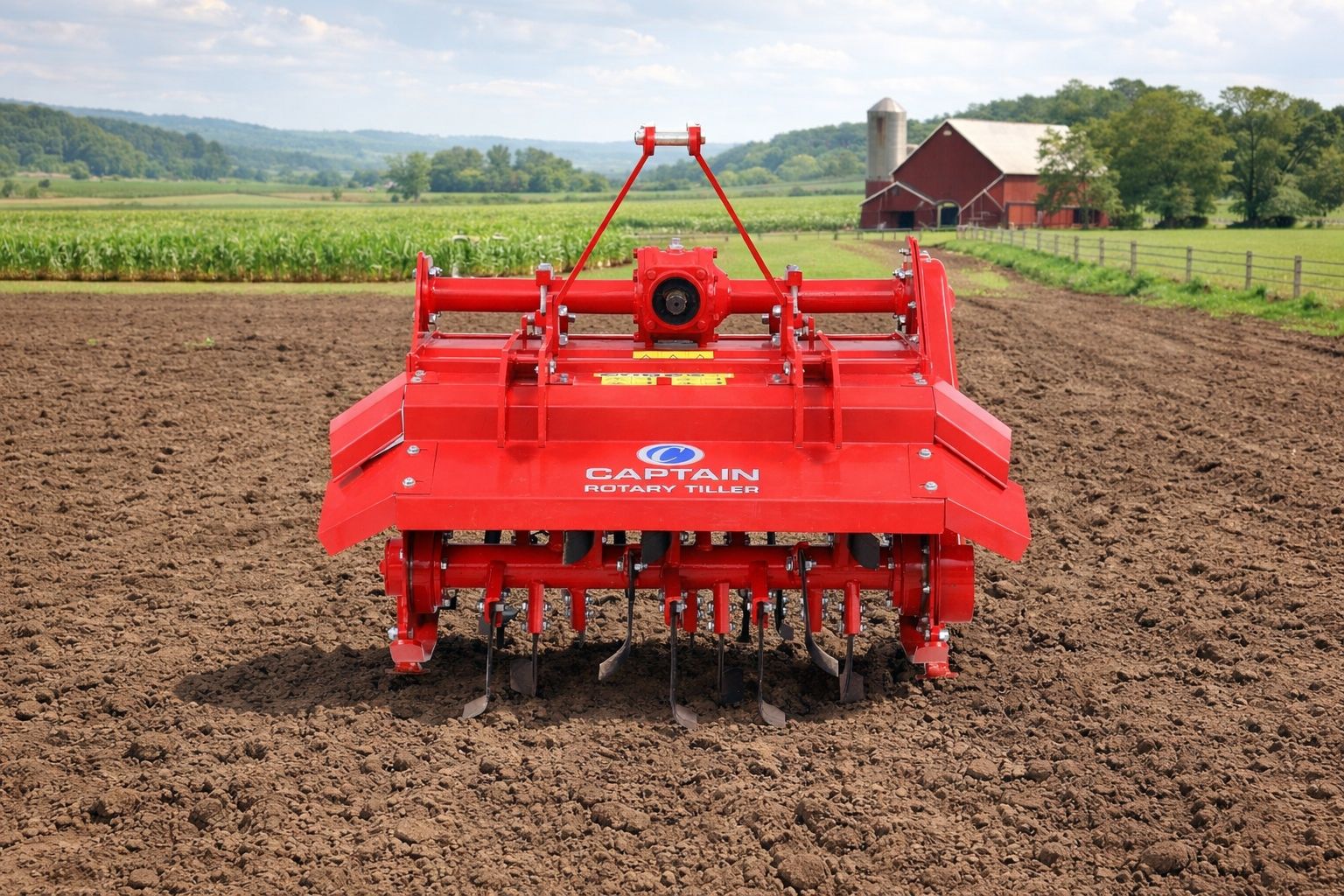
Captain Tractors produces the Reverse Forward Rotary Tiller (Rotavator) in three models, tailored for various tractor sizes and field needs. Whether you have a compact 15 HP tractor or a stronger 28 HP machine, there’s a model that matches your setup perfectly.
Each version is carefully designed with the appropriate working width and power compatibility, ensuring you achieve efficient performance in your field effortlessly.
Specification | Model TRT121 (0.6M) | Model TRT122 (0.8M) | Model TRT123 (1.2M) |
|---|---|---|---|
| Tractor Power (HP) | 15–22 HP | 18–25 HP | 22–28 HP |
| No. of Blades | 16 | 22 | 34 |
| Working Width (mm) | 508 mm | 688 mm | 1048 mm |
| Max Working Depth (mm) | 112 mm | 112 mm | 112 mm |
| Rotor Shaft Speed (RPM @540) | 258 RPM | 258 RPM | 258 RPM |
| PTO Input Speed (RPM) | 540 RPM | 540 RPM | 540 RPM |
| Side Transmission | Chain | Chain | Chain |
| Three-Point Hitch | CAT-1N | CAT-1N | CAT-1N |
| Overall Length (mm) | 878 mm | 1060 mm | 1478 mm |
| Overall Width (mm) | 1003 mm | 1003 mm | 1003 mm |
| Overall Height (mm) | 998 mm | 998 mm | 998 mm |
| Rotor Swing Diameter (mm) | 530 mm | 530 mm | 530 mm |
| Weight (kg) | 168 kg | 186 kg | 224 kg |
Salient Features of Captain Reverse Forward Rotavator
1. 2-in-1 Direction in One Machine
The standout feature, a single machine that operates in both forward and reverse directions. No need to buy two separate implements. Switch direction based on your crop and soil requirement.
2. Superior Soil Pulverization
The reverse direction creates a lifting and throwing action that breaks even hard clay clods into fine, crumbly soil. This is significantly better than standard rotavators for achieving a fine seedbed in fewer passes.
3. Better Soil Throw Coverage
The extended cover can be adjusted or removed to increase soil throw width, ensuring even distribution across the field.
4. Depth Adjustment as Per Soil and Crop Condition
Working depth can be adjusted up to 112 mm, allowing the farmer to match tillage depth to crop requirement, shallow for vegetable beds, deeper for sugarcane and heavy soils.
5. Support Frame for Balance and Stability
A dedicated support frame ensures the implement stays balanced during operation, reducing vibration and improving driver comfort.
6. Parking Stand to Hitch and Unhitch Easily
A built-in parking stand makes it easy to hitch and unhitch the implement from the tractor without requiring additional help.
7. Transparent Oil Level Check Nut
The side drive gearbox features a transparent nut for easy visual inspection of oil levels — no need to open the gearbox during maintenance checks.
8. Low Maintenance Design
Chain-drive side transmission, sealed gearbox, and sturdy blade holders reduce maintenance frequency and cost significantly.
9. Enhances Fuel Efficiency
By achieving desired soil preparation in fewer passes, the reverse forward rotavator reduces total engine run time, directly saving fuel costs per acre.
10. Longer Blade Life
High-quality blade steel and optimized blade geometry ensure blades last longer even in rocky or hard soils.
11. High Productivity
Covers more ground effectively with each pass. Dual-direction capability means less re-tilling, saving time and labour costs.
12. Comfortable to Operate
Balanced weight distribution, stable frame, and smooth PTO-driven operation make it comfortable for long hours in the field.
Key Benefits of Reverse Forward Rotavator
1. Time Saving — Up to 40–50% Faster Field Preparation
Here is something worth thinking about. With a standard rotavator, getting the soil fine enough often takes 2 to 3 passes over the same ground. The reverse forward rotavator does it in one, sometimes two at most. That is 40 to 50% less time spent on land preparation.
To put it plainly: if you farm 10 acres, you are looking at saving a full day of tractor work every single season. That is fuel saved, that is labour saved, and that is time you can spend on other things.
2. Fuel Saving
Fewer passes = less fuel consumed. With diesel prices rising steadily, even a 30–40% reduction in fuel use per acre makes a significant difference to farm input costs, especially for small and medium farmers.
3. Excellent for Crop Residue Management
After harvest, leftover stubble and straw can be a real headache. Instead of burning (and risking fines), the reverse mode pushes all that residue into the soil, where it breaks down into organic matter and improves soil health.
4. Superior Weed Control
Counter-rotating blades push weed seeds and shallow-rooted weeds deep into the soil, making it hard for them to sprout — this cuts down on the need for manual weeding and herbicide expenses.
5. Ideal for Wet and Puddled Soil Conditions
Standard rotavators struggle in sticky wet soil. The reverse forward rotavator handles wet paddy fields effectively, making it ideal for transplanting operations.
6. Versatile Across Multiple Crops and Soil Types
From sandy loam in Gujarat to black cotton soil in Maharashtra and alluvial soil in Punjab, the reverse forward rotavator adapts to different soil types by switching direction and adjusting depth. No other single rotavator implement offers this flexibility.
7. Earthing Up in Row Crops
The reverse direction is uniquely suited for earthing up soil around sugarcane, banana, and vegetable rows, a job previously done manually or with specialized ridgers. This saves significant labour cost.
8. Earthing Up in Row Crops
While the reverse forward rotavator costs more than a standard rotavator, the fuel savings, labour savings, reduced number of passes, and multi-crop versatility together deliver a strong ROI, typically within 1–2 seasons for medium to large farms.
Applications of Reverse Forward Rotavator
Crop-Wise Applications
Here is the breakdown of how the Reverse Forward Rotavator is utilized across various crops with specific tasks and the rotation direction used.
Crops Using Reverse Rotation
- Sugarcane: Primarily used for earthing up rows and performing deep soil breaking in the spaces between rows.
- Banana: Essential for inter-row cultivation, loosening the soil, and earthing up around the plants.
- Vegetables: Used to create a fine seedbed, form raised beds, and manage inter-row cultivation for delicate crops.
- Coconut: Helps with inter-tree soil loosening and efficiently mixing organic matter into the ground.
- Cotton: Employed for deep soil breaking and managing heavy crop residue after harvest.
Crops Using Forward Rotation
- Wheat: Focuses on seedbed preparation and ensuring that previous crop residues are properly incorporated into the soil.
- Maize / Corn: Used for creating an ideal seedbed and chopping/burying stubble from the previous season.
- Pulses: Specifically used to achieve a fine tilth, which is necessary for the even germination of small seeds.
Crops Using Both / Combined Rotations
- Paddy / Rice (Reverse + Forward): A combination is used for puddling wet fields and ensuring stubble is thoroughly buried in the mud.
- Garden Crops (Both): Offers precision soil preparation tailored to the needs of small, diverse plots.
Quick Tip: Reverse rotation is generally better for "digging in" and deep soil engagement, whereas forward rotation excels at "finishing" the surface and preparing a smooth, level seedbed.
Soil-Type Applications
Hard & Heavy Soil → Use Reverse Rotation
- Black Cotton Soil — Maharashtra, Gujarat, MP
- Red Laterite Soil — Karnataka, AP, Tamil Nadu
- Clayey Wetland (Paddy) — West Bengal, Odisha, Assam
Soft & Standard Soil → Use Forward Rotation
- Alluvial Soil — Punjab, Haryana, UP, Bihar
Sandy Soil → Use Both (Forward + Reverse)
- Sandy Loam — Rajasthan, Gujarat
Versatile Soil → Both Directions Work
- Loamy Soil — Most of India
Operation-Type Applications
- Primary Tillage: Breaking virgin or fallow land
- Secondary Tillage: Refining already-ploughed soil
- Seedbed Preparation: Fine tilth before sowing
- Inter-row Cultivation: Between standing crop rows
- Earthing Up: Mounding soil around plant base
- Puddling: Wet-field preparation for paddy transplanting
- Weed Control: Burying weeds before sowing
- Residue Management: Incorporating crop stubble
Which Tractor HP is Right for Captain Reverse Forward Rotavator?
Choosing the wrong tractor for your rotavator is an expensive mistake that many farmers make. If your tractor has too little horsepower (HP), it will struggle to pull the load, putting extreme stress on the PTO shaft and wearing out the gearbox prematurely.
To avoid breakdowns and high repair costs, always ensure your tractor's power matches the rotavator's requirements.
Here are Captain rotavator models with the ideal tractor power requirement:
TRT121 (0.6M)
- Working Width: 508 mm
- Recommended Tractor HP: 15-22 HP
- Best for: Small farms, vegetable gardens, orchard inter-rows
TRT122 (0.8M)
- Working Width: 688 mm
- Recommended Tractor HP: 18-25 HP
- Best for: Medium farms, sugarcane, banana
TRT123 (1.2M)
- Working Width: 1048 mm
- Recommended Tractor HP: 22-28 HP
- Best for: Large fields, paddy, wheat, cotton
Important: Always ensure that the tractor's horsepower is within the recommended range. Tractors that are under-powered can put stress on the PTO shaft and gearbox, which can greatly shorten the lifespan of the implement. For best performance, the PTO shaft should operate at 540 RPM.
Compatible Captain Tractor models include the Captain 250 DI (2WD/4WD), Captain 283 4WD, Captain 200 DI LS 4WD, and other models in the 15–28 HP range. For detailed tractor selection guidance, read our
For detailed tractor HP selection, read our Tractor Horsepower Guide: Find the Best Fit for Your Farm Work.
Reverse Forward Rotavator vs Standard Rotavator — Complete Comparison
Parameter | Reverse Forward Rotavator | Standard Rotavator |
|---|---|---|
| Directions of Operation | 2 (Forward + Reverse) | 1 (Forward only) |
| Soil Pulverization Quality | Finer, deeper | Standard |
| No. of Passes Required | 1–2 passes | 2–4 passes |
| Fuel Efficiency | Higher (fewer passes) | Lower |
| Time per Acre | Less | More |
| Weed Control | Excellent (deep burial) | Good |
| Crop Residue Management | Excellent | Moderate |
| Earthing Up Capability | Yes (reverse mode) | No |
| Paddy Puddling | Excellent | Limited |
| Versatility (Crops) | Very High | Moderate |
| Cost | Higher | Lower |
| Maintenance Complexity | Slightly higher | Lower |
| Best For | Multi-crop, heavy soil, row crops | General field preparation |
Verdict: If you grow a single crop on flat, easy soil, a standard rotavator may be sufficient. But if you grow multiple crops, have heavy or clayey soil, grow sugarcane or vegetables, or want to reduce passes and save fuel, the Reverse Forward Rotavator is clearly the better long-term investment.
Also read: Benefits of Using Rotavators for Soil Preparation Before Rabi Sowing
5 Myths About Reverse Forward Rotavator — Busted
Myth 1: "It is only for big farms"
Reality: The 0.6M model (TRT121) is designed specifically for 15–22 HP small tractors and works perfectly on small farms, vegetable plots, and orchards. Even a 2–5 acre farmer benefits from its dual-direction capability.
Myth 2: "A forward rotavator does the same job"
Reality: A forward rotavator cannot earth up rows, cannot puddle wet paddy fields as effectively, and needs more passes to achieve the same fineness of tilth. They are fundamentally different tools.
Myth 3: "It consumes too much fuel"
Reality: Because it achieves better soil preparation in fewer passes, total fuel consumption per acre is actually lower than using a standard rotavator for 3–4 passes.
Myth 4: "Maintenance is very complicated"
Reality: Captain's Reverse Forward Rotavator uses a simple chain-drive side transmission, sealed gearbox, and a transparent oil check nut ; making routine maintenance easy for any farmer.
Myth 5: "It is not suitable for Indian soil conditions"
Reality: Reverse forward rotavators are specifically well-suited for Indian conditions — black cotton soil in Maharashtra, clayey paddy fields in Bengal, and heavy sugarcane-growing soils in UP, all benefit greatly from the reverse direction.
Maintenance Tips to Increase Your Rotavator’s Life
• Always check gearbox oil before starting, it prevents serious damage
• Grease all moving parts every 8 hours or bearings will wear out fast
• Every 20 hours, check chain tension and tighten blade bolts, loose blades are dangerous
• Check blade sharpness every 8–10 acres, dull blades burn 20–30% more fuel
• Replace worn blades whenever needed, don't wait too long
• Change gearbox oil every 150–200 hours for smooth operation
• Before each season, check PTO shaft alignment, misalignment kills the gearbox
• After every use, clean off all soil and residue to avoid rust and clogging
• At the end of season, clean everything, grease it up, and store under cover
How to Choose the Right Reverse Forward Rotavator
Step 1: Match Model to Your Tractor HP
Begin with the HP rating of your tractor. Refer to the compatibility table above and choose the model that matches your tractor's power range. Avoid overloading your tractor.
Step 2: Identify Your Primary Crops
If you primarily grow sugarcane, banana, or vegetables, you will use the reverse mode heavily. If you mainly grow wheat and cereals, forward mode will be your primary use. Both scenarios benefit from having the reverse option available.
Step 3: Check Your Soil Type
Heavy black cotton or clayey soil? You will greatly benefit from the reverse direction's deeper pulverization. Light sandy soil? A standard or forward operation may suffice.
Step 4: Consider Your Field Size
Wider working width = faster coverage but higher HP needed. Match working width to your farm size and tractor capacity.
Step 5: Check Government Subsidy Availability
Under the Sub-Mission on Agricultural Mechanization (SMAM) scheme, farmers can get 40–50% subsidy on agricultural implements including rotavators. Check with your state agriculture department or
Read more: SMAM – A Boon to Indian Farmers for subsidy details.
Step 6: Verify After-Sales Service
A rotavator is a field machine — blades wear, chains need adjusting. Always buy from a brand with a strong dealer network and spare parts availability in your region.
View Captain Reverse Forward Rotary Tiller product details.
Conclusion
The Reverse Forward Rotavator is not just another tractor implement, it is a genuine upgrade in how Indian farmers prepare their land. Its dual-direction capability, deeper soil pulverization, fuel savings, versatility across crops and soils, and suitability for earthing up and puddling make it one of the most valuable investments a progressive farmer can make.
Whether you are a small farmer in Gujarat growing vegetables, a sugarcane farmer in Maharashtra, or a paddy cultivator in West Bengal, the reverse forward rotavator has a specific, valuable role to play in your farming operation.
Captain Tractors manufactures the Reverse Forward Rotary Tiller in three models (TRT121, TRT122, TRT123) suitable for 15–28 HP tractors, backed by quality engineering and a strong service network.
Frequently Asked Questions (FAQs)
Q1. What is the difference between a reverse forward rotavator and a standard rotavator?
A standard rotavator works only in forward direction. A reverse forward rotavator works in both directions — forward for standard tillage and reverse for deeper pulverization, earthing up, and puddling. This makes it significantly more versatile.
Q2. Which tractor HP is needed for a reverse forward rotavator?
Captain's reverse forward rotavator models are suitable for tractors ranging from 15 HP to 28 HP. The 0.6M model suits 15–22 HP, the 0.8M model suits 18–25 HP, and the 1.2M model suits 22–28 HP tractors.
Q3. Is a reverse forward rotavator good for sugarcane farming?
Yes — the reverse mode is specifically excellent for sugarcane earthing up, which is traditionally a labour-intensive operation. It can earth up rows efficiently, saving significant manual labour.
Q4. Can a reverse forward rotavator be used for paddy puddling?
Yes. The reverse direction's counter-rotating blades are very effective for puddling wet paddy fields before transplanting, creating the fine muddy consistency needed for good rice seedling establishment.
Q5. How many blades does a reverse forward rotavator have?
Captain's models have 16 blades (0.6M), 22 blades (0.8M), and 34 blades (1.2M) depending on the working width.
Q6. What is the working depth of a reverse forward rotavator?
The maximum working depth is 112 mm, and it can be adjusted as per soil condition and crop requirement.
Q7. Is there a government subsidy for buying a reverse forward rotavator?
Yes. Under the SMAM (Sub-Mission on Agricultural Mechanization) scheme, eligible farmers can avail 40–50% subsidy on agricultural implements. Contact your district agriculture office or check the official DBT Agriculture portal for eligibility.
Q8. Which crops are best suited for a reverse forward rotavator?
Sugarcane, banana, rice/paddy, vegetables, wheat, cotton, maize, and garden crops all benefit from a reverse forward rotavator. It is especially transformative for row crops that require earthing up.
Q9. How is a reverse forward rotavator different from a rotary tiller?
A rotary tiller and a rotavator are the same implement — the term rotary tiller is more common internationally while rotavator is the more common Indian terminology. A reverse forward rotary tiller = reverse forward rotavator.
Q10. Where can I buy a Captain Reverse Forward Rotavator?
You can visit captaintractors.com/implements/reverse-forward-rotavator for product details, or contact us at 97262 70707 / 92280 18432 or email info@captaintractors.com.
Loading...