July 14, 2026
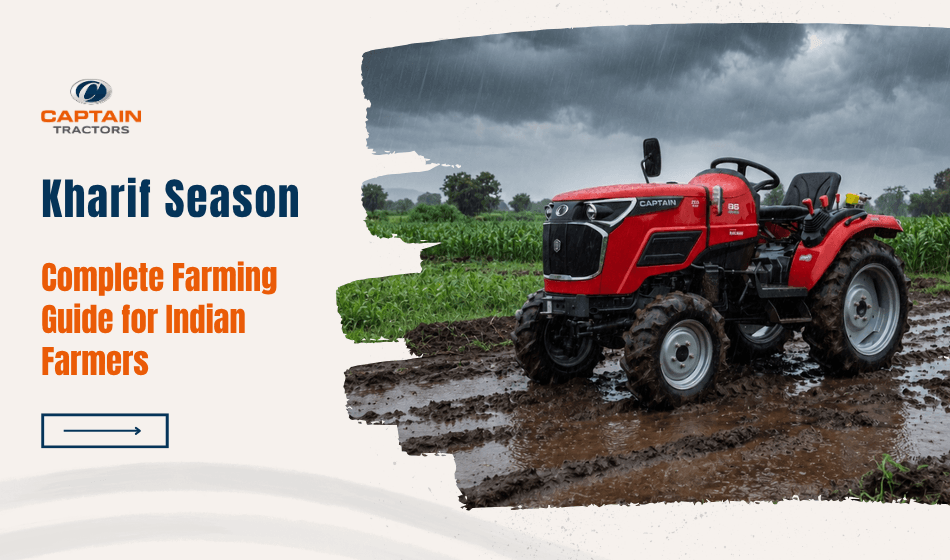
Kharif Season: Complete Farming Guide for Indian Farmers
Introduction
The Kharif season begins with the arrival of the monsoon, and every day counts. Fields need to be ready before the first good rains. If land preparation is delayed, sowing gets pushed back, which can affect crop establishment. Even a small issue with a tractor or implement during this period can lead to valuable time being lost. Unlike the Rabi season, where weather conditions are more predictable, Kharif operations depend on timely rainfall, making preparation even more important.
More than half of India's total food grain production comes from this single monsoon season. Rice, cotton, groundnut, maize, soybean, bajra, pulses, crops grown by millions of farmers across the country, all sown within a few weeks of each other as the monsoon arrives. The margin between a good Kharif and a disappointing one often comes down to what was done or not done in the weeks before the rains.
This guide walks through the full picture: what the Kharif season is, when to act at each stage, which implements matter and why, and a regional look at how Kharif farming works on the ground.
What Is the Kharif Season?
Kharif is the biggest farming season in India and the most important one for many farmers. It starts with the southwest monsoon, usually around June, although the timing is different in every region. Farmers sow their crops after the rains begin, and harvesting is usually finished by October.
The word Kharif means autumn, but the work starts long before harvest. Before the monsoon arrives, farmers have only a few weeks to prepare their fields ready for sowing.
What separates Kharif from Rabi is simple: water source. Kharif crops run on monsoon rainfall. They're sown into warm, humid soil and grow through the wet months. Rabi crops, by contrast, are sown after the monsoon, into stored moisture and cooler temperatures, often with canal or groundwater irrigation. A delayed or weak monsoon hits Kharif hard in a way it doesn't hit Rabi - there's no substitute for rainfall when that's what the whole system runs on.
For a complete explanation of Kharif, Rabi, and Zaid, along with their cropping patterns and growing conditions, visit our guide on types of crop seasons in India.
Parameter | Details |
| Sowing Period | June – July |
| Harvest Period | September – October |
| Water Source | Primarily monsoon rainfall |
| Climate Required | Warm, humid, high rainfall |
| Major Crops | Rice, Cotton, Groundnut, Maize, Soybean, Bajra, Pulses |
Understanding this basic framework is what helps a farmer plan every decision that follows from soil preparation timing to implement selection to pest management.
Major Kharif Crops Across India
India's farming is too diverse for a single Kharif story. What a paddy farmer in the east does in June looks nothing like what a cotton farmer in central India does, or what groundnut growers across the west and south are managing. Same season, very different crops and soil realities.
Rice (Paddy) is the most widely grown Kharif crop across the country - wherever water is sufficient, paddy follows. It's also the most labour-intensive to prepare, because the field itself has to be flooded and puddled before transplanting begins. You can discover more about puddling in the detailed section below.
Cotton thrives in deep, black, moisture-holding soils and is one of the most important cash crops of the Kharif season. It goes in during June–July and stays in the field well into October. Ridge-and-furrow land preparation is standard - it manages drainage and keeps root zones aerated through the monsoon months.
Groundnut needs the opposite of what cotton likes - loose, sandy loam soil with sharp drainage. It's a major Kharif oilseed crop across western and southern parts of India. Pod formation happens underground, so a well-broken, clod-free seedbed isn't just helpful - it directly affects how many pods form and how well they fill.
Maize is a fast crop. It establishes quickly but demands consistency - uniform seed depth and good soil contact at sowing, or germination turns patchy.
Soybean has spread rapidly as a Kharif crop over the past two decades. It needs good drainage and a reasonably fine seedbed. Waterlogging early in the season hits soybean hard.
Pulses - arhar, moong, urad - are grown across large stretches of central and peninsular India. Relatively lower water demand than the other Kharif crops, and they return nitrogen to the soil after harvest, which benefits whatever comes next.
Bajra and Jowar go where rainfall is lower and soils are lighter. Drought-tolerant, but still responsive to a properly prepared seedbed and timely sowing.
The land preparation requirements differ crop to crop - but the common thread is that preparation quality at the start shapes everything that follows.
Kharif Farming Calendar: When to Do What
The most common reason Kharif farming underperforms isn't soil quality or seed quality. It's timing. Missed windows at any stage - pre-monsoon preparation, sowing, interculture, or spraying - compound into yield losses that can't be recovered.
Pre-Monsoon (April – May): Prepare Before the Rain
April and May are the best months to prepare for the Kharif season. The soil is still dry, making it easier to work in the field. If deep ploughing is needed, it's better to finish it before the monsoon arrives.
Use an MB plough or disc plough to turn the soil. This helps mix old crop residue into the soil and brings insects and weeds to the surface, where heat from the sun can reduce their numbers. If your field has hard soil, deep tillage should also be done during this time.
Before the season starts, check all your implements. Replace worn or damaged parts and make sure everything is ready to use. Finding a broken implement after the rains begin can delay sowing.
Also, keep the right seeds ready before the monsoon. Buying seeds at the last minute can delay planting and reduce the chances of timely sowing.
Early Monsoon (June - July): Sow at the Right Moment
Once the monsoon brings steady rainfall, sowing begins. This is the busiest time of the Kharif season, so fields should already be prepared before the rains become regular.
A rotavator or cultivator is then used to break soil clods and level the field, creating a good seedbed. A rotavator can do this in a single pass, saving both time and fuel.
Using a seed drill helps place seeds at the right depth and spacing while applying fertilizer at the same time. This leads to more even germination and better crop growth than broadcasting seeds by hand.
For paddy farmers, this is also the stage when field flooding and puddling begin, which we'll discuss in the next section.
Mid-Season (August - September): Manage, Monitor, Spray
By August, the crop is growing well, but the work is not over. This is the time when weeds, pests, and diseases become more common because of the warm and wet weather.
Weeds should be removed in the first few weeks after the crop emerges. If they are left for too long, they compete with the crop for water and nutrients, which can reduce yield. Using a cultivator between the rows early is much easier and more effective than removing large weeds later.
This is also the right time to keep a close watch for pests and diseases. Don't wait until the damage becomes visible. A tractor-mounted boom sprayer helps spray the field quickly and evenly. This is especially important for crops like cotton and soybean, where timely spraying helps control pests before they cause serious damage.
Post-Monsoon (October onwards): Harvest and Prepare
As the monsoon ends and the crops are ready, harvesting begins. Tractors with trailers help carry the harvested crop from the field to storage or the market. They save time and reduce crop losses that can happen during manual handling.
After harvesting, the soil usually has enough moisture for light tillage. This is a good time to mix crop residues back into the soil and prepare the field for the next crop, whether it's a Rabi crop or a soil restoration period.
Key Implements for Kharif Season Farming
Different stages of Kharif farming need different implements. Here's a practical guide to what does what - and when each one earns its value.
MB Plough - Primary Tillage
The Mould Board Plough goes in first - before anything else happens. It inverts the soil completely, turning residues and surface weeds under and exposing the lower layers to air and heat. Do this in the pre-monsoon period when the ground is dry. Wet soil ploughing is slower, harder on the tractor, and produces poorer results. On fields with compaction from repeated seasons of heavy machine traffic, a good MB plough pass in April or May sets up everything that follows.
Rotavator - Secondary Tillage and Seedbed Preparation
Once the field is ploughed, a rotavator handles the finishing work - breaking remaining clods, mixing organic matter, and levelling the surface in a single pass. The seedbed it produces is fine and uniform, which matters more than it sounds. Uneven seedbeds give uneven germination, and uneven germination at Kharif sowing time is a problem that compounds through the season. For a crop where every growing day counts, getting this step done in one pass rather than two or three is worth the investment.
Cultivator - Weed Control and Soil Aeration
Few implements get used as consistently through the Kharif season as the cultivator. Pre-sowing, it loosens compacted surface soil and aerates it before the seedbed is finished. Post-sowing, it runs between rows to cut weeds at the root before they establish. After a heavy monsoon rain, it opens up surface crust and improves aeration - something paddy and upland crops both benefit from. Simple implement, used repeatedly, and the return on each pass is visible.
Mechanical Seed Drill - Uniform Sowing
Broadcasting seed is fast. It's also imprecise - depth varies, spacing is uneven, and fertilizer placement is separate. A mechanical seed drill puts seed at consistent depth, correct spacing, and applies fertilizer in the same pass. Germination is more uniform, plant population is more consistent, and seed use is more efficient. For most Kharif crops, that consistency at establishment is one of the better investments available before the season even starts.
Ridger - Row Crop Preparation
Row crops like cotton and groundnut grow in a ridge-and-furrow system - raised soil beds that keep root zones above waterlogging risk, with furrows that carry irrigation water evenly across the field. A ridger shapes that structure before sowing. Get the ridges right and water management through the monsoon months becomes significantly easier. On fields where the soil is hard or compacted going into ridge preparation, the Captain Chisel Ridger breaks through the compacted layer first before forming the ridge - one pass instead of two separate operations.
Boom Sprayer - Crop Protection
Pest and disease pressure is highest during the warm, humid weeks of the monsoon. A tractor-mounted boom sprayer delivers even chemical coverage across the canopy, reaching more of the field in less time than knapsack sprayers while ensuring uniform application. Timely, uniform spraying at the first sign of pest activity is far more effective than reactive applications after damage has already spread.
Trailer - Field Logistics
Harvest without a reliable transport system creates its own losses. A tractor trailer moves seeds, fertilizers, and harvested produce efficiently across the farm - reducing damage from rough handling and saving the time and labour that manual transport requires.
Puddling in Paddy Farming: Why It Matters and How to Do It Right
What Is Puddling? Puddling is simply preparing a paddy field by working the soil while it is covered with a shallow layer of water (about 5–10 cm). The goal is to break the soil into a soft, muddy layer that holds water well.
This step is important because rice is not directly sown in dry soil like many other crops. Instead, young rice seedlings are transplanted into this soft, wet field.
Good puddling makes the soil:
- soft enough for seedlings to be planted easily
- firm enough to hold the plants upright
- level so water spreads evenly across the field
In short, puddling creates the right “bed” for rice to grow well right from the start.
Why Puddling Is Done
1. Saves water
In a normal (non-puddled) field, water quickly seeps deep into the soil and gets wasted. Puddling makes the top soil tight and muddy, so water stays near the surface where the rice needs it. This means less irrigation is needed.
2. Controls weeds
When we puddle the field, many young weeds get pulled out and buried. After that, the standing water makes it hard for new weeds to grow. So the field stays much cleaner.
3. Helps easy planting
In a well-puddled field, rice seedlings can be planted smoothly and stand upright. If the soil is hard or uneven, roots get damaged and plants struggle to grow properly.
4. Helps nutrients work better for rice
Flooded, muddy soil creates special conditions that suit rice. In this environment, nutrients behave in a way that rice can use more effectively.
How Puddling Is Done
Start by flooding the field with about 5–10 cm of water. Let it sit for 1–2 days so the soil can fully soak and soften.
Next, do the first ploughing using an MB plough or disc plough. This breaks the wet soil and starts mixing it into mud.
After about 5–7 days, do a second pass with a puddler or rotavator. This breaks any remaining clumps, makes the soil more uniform, and removes any weeds that have started growing again.
Then level the field properly so water spreads evenly everywhere. If the field is uneven, some parts will stay too dry while others get too wet, which affects crop growth.
Finally, adjust the water to a shallow level and transplant the rice seedlings within a day or two. At this stage, the soil is soft, smooth, and ready for planting.
Implements Used in Puddling
The rotavator performs exceptionally well as a puddling implement. It churns wet soil efficiently, breaks clods, and mixes the soil thoroughly in fewer passes than a traditional country plough. For fields where energy efficiency and time matter, a rotavator reduces the total labour and fuel cost of puddling compared to older methods.
A puddler (specifically designed for wet field churning) is used in traditional paddy cultivation and works effectively in small to medium fields. The MB plough handles the initial deep loosening before the puddler finishes the seedbed. In waterlogged paddy fields cage wheels fitted to the tractor provide better grip and prevent the tractor from sinking into wet soil - an important practical consideration when running any implement in a flooded field.
For paddy farmers interested in understanding puddling implements in more detail, see the Captain Tractors guide on best implements for puddling in rice farming.
Kharif Farming in Gujarat: A Closer Look
Gujarat is one of India's most important Kharif farming regions, with groundnut and cotton as its two dominant cash crops. Farmers across the state grow these two crops across a wide range of field sizes and soil conditions from the sandy soils suited to groundnut to the deep, moisture-retentive black cotton soils.
Groundnut is Gujarat's most significant Kharif oilseed crop. It requires a well-aerated, loose seedbed for underground pod formation. The soil needs to be broken and levelled thoroughly before sowing - compacted or cloddy soil reduces pod count directly.
Cotton is a long-season ridge crop. The field goes into a ridge-and-furrow system before sowing - ridges keep roots above the waterline during heavy monsoon rains, and furrows carry irrigation water down the rows evenly. Cotton stays in the field from June right through to October, so getting the structure right at the start matters through the whole growing period.
Both crops demand proper ploughing, a well-finished seedbed, season-long weed management, and timely spraying for the pest and disease pressure that builds through the monsoon. The implements used are largely the same - the sequence and timing vary by crop.
Implements That Work for Gujarat's Kharif Crops
For groundnut, the sequence is MB plough for primary tillage → rotavator for seedbed → seed drill for sowing → cultivator for interculture weeding → boom sprayer for pest and disease management.
For cotton, the sequence adds ridge preparation: MB plough → rotavator or cultivator for secondary tillage → ridger for ridge formation → seed drill or manual sowing → cultivator for weeding between rows → sprayer for pest management → trailer for harvest transport.
Where Captain Tractors Fits In
Captain Tractors, based in Gujarat and manufacturing compact tractors since 1994, builds machines specifically for small and medium farm operations. The 12 HP to 20 HP tractor range from Captain is designed for exactly the scale of farming that dominates across large parts of India - fields where a 50 HP tractor is too large, too heavy, and too expensive to operate efficiently.
Two models in particular suit Gujarat's Kharif crops well. The Captain 200 DI 2WD is a strong choice for groundnut farmers - it handles rotavator, seed drill, and cultivator operations efficiently on medium holdings and keeps fuel costs manageable through a full season. For cotton farmers who need better traction on heavy, moisture-retentive black soil and work with a wider implement range, the Captain 250 DI 4WD offers improved grip and higher lift capacity for the ridger, MB plough, and sprayer operations that cotton demands.
These compact machines are built to run the full range of Kharif implements - rotavator, MB plough, cultivator, seed drill, ridger, sprayer, and trailer - with fuel efficiency suited to small farm economics. The implements are designed and tested to work with the tractor range, so farmers aren't combining equipment that wasn't meant to work together.
For Gujarat farmers growing groundnut or cotton, Captain's 12–20 HP range offers a practical, affordable entry point into mechanised Kharif farming that covers every operation from pre-monsoon tillage to post-harvest transport. Learn more about the Captain mini tractor range and the full implements lineup built to go with them.
Common Kharif Farming Mistakes to Avoid
Delaying pre-monsoon tillage. Ploughing hard, dry soil before the rains is far easier than doing the same work in wet, heavy monsoon soil. Every day of delay in pre-monsoon preparation means more difficult, slower work when time is most scarce.
Broadcasting seed instead of drilling. Seed broadcasting is fast but uneven. Inconsistent depth and spacing means patchy germination, uneven plant populations, and difficulty with mechanical interculture later. A seed drill pays for itself in better crop establishment across the season.
Skipping weeding in the early weeks. Weed competition in the first three to four weeks after sowing has the highest yield impact. Delaying a cultivator pass until weeds are large and established means the crop has already lost ground it can't recover.
Reactive pest management. Waiting until pest damage is visible before spraying means the crop has already suffered. Monitoring from the first weeks of the season and acting at economic threshold levels - not at crisis levels - is what effective Kharif pest management looks like.
Incomplete puddling for paddy. A single shallow pass in a paddy field is not puddling. The two-pass process at the right water depth, with levelling afterward, is what creates the seedbed that paddy transplanting requires. Shortcuts at this stage affect the entire crop.
Skipping implement maintenance. Worn plough tips, loose seed drill metering mechanisms, blocked sprayer nozzles - all of these reduce implement performance quietly, without obvious failure. Pre-season servicing is not optional in a season where every week of the window matters.
Frequently Asked Questions
What is the Kharif season and when does it start? The Kharif season is India's monsoon cropping season, starting with the arrival of the southwest monsoon in June and ending with harvest in September–October. Sowing begins in June–July depending on the region and crop.
Which crops are grown in the Kharif season? Major Kharif crops include rice (paddy), cotton, groundnut, maize, soybean, bajra, jowar, and pulses like arhar, moong, and urad. Each crop has specific soil, water, and land preparation requirements.
What is puddling and why is it important in paddy farming? Puddling is the ploughing of a paddy field in standing water to create a soft, muddy seedbed for transplanting rice seedlings. It reduces water percolation losses, suppresses weeds, and creates the right soil condition for paddy establishment. It is the most critical land preparation step in rice cultivation.
Which implement is best for puddling? A rotavator works very effectively for puddling in wet paddy fields, combining churning and mixing in fewer passes. A puddler or MB plough is used for the initial deep loosening before the finishing pass.
What HP tractor is needed for Kharif farming on a small farm? A 12 HP to 20 HP compact tractor handles the full range of Kharif implements - rotavator, MB plough, cultivator, seed drill, ridger, and sprayer - efficiently on small and medium farms. Larger tractors are not necessary for these operations and are less fuel-efficient on smaller holdings.
How early should a farmer start preparing for Kharif season? Preparation should begin in April–May, well before the monsoon arrives. Pre-monsoon tillage, implement servicing, and seed procurement done during this window means the farm is ready to act the moment rains begin - not scrambling to catch up after the sowing window has already opened.
Why does timely sowing matter so much in Kharif? Kharif crops are temperature and rainfall dependent. Late sowing means less growing time before harvest, reduced yield potential, and often greater pest pressure because the crop is out of sync with its natural growing calendar. The difference between sowing on time and sowing two weeks late can be significant for most Kharif crops.
Final Thoughts
The Kharif season is demanding and time-sensitive. But it is also the season with the highest yield potential for most Indian farmers and the one where preparation makes the biggest difference between a good harvest and a missed one.
The farmers who get the most from Kharif don't necessarily work harder during the season. They work earlier, getting the soil ready, getting implements in order, and getting seed in the ground at the right time. When the monsoon arrives, they are ready to move with it instead of chasing it.
Whether you grow paddy in a water-rich region, cotton or groundnut in the drier west, or a mix of crops across a medium holding, the principles are the same: prepare the land properly, sow at the right time, manage weeds and pests before they compound, and handle the harvest efficiently.
Captain Tractors designs compact tractors and a full range of Kharif-ready implements - rotavator, MB plough, cultivator, seed drill, ridger, sprayer, and trailer - built for Indian soil conditions and sized for small and medium farms. If you're preparing for the Kharif season and want to know which implements suit your crops and field size, visit captaintractors.com or connect with the nearest Captain dealer.
The season won’t wait but a well-prepared farm is always one step ahead and ready to make the most of it.
Loading...