July 21, 2026
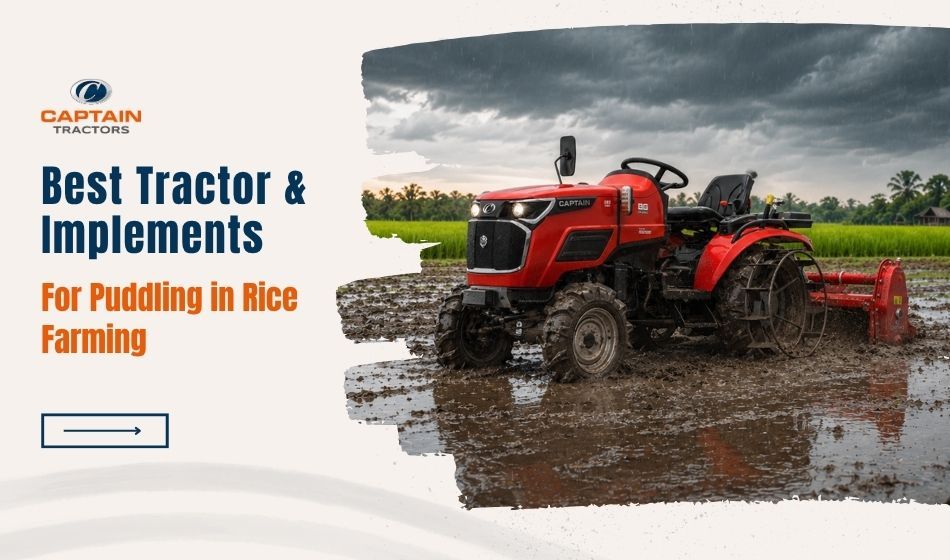
Best Tractor Implements for Puddling in Rice Farming
A good rice crop starts long before transplanting. The first important step is puddling mixing water and soil to create a soft, level field. Proper puddling helps reduce water loss, controls weeds, and gives young rice plants a better environment to grow.
For many years, farmers used bullocks and hand tools for puddling. While these methods are still used in some areas, they take more time and effort. Today, many farmers use tractors with puddling implements to finish the job faster and more efficiently, especially during the short monsoon season.
The implement you choose can affect fuel use, water conservation, and how well the field is prepared. Whether you have a small farm or a large one, using the right puddling equipment can help your rice crop get off to a strong start. In this guide, we'll look at the most common rice puddling implements and how to choose the right one for your farm.
What Is Puddling in Rice Farming?
Puddling, in simple terms, is tilling a flooded field, running through standing water, usually five to ten centimetres deep, until the soil breaks down into a soft, sticky mass. It happens before transplanting, never after.
Poor puddling can affect the crop from the very beginning. It reduces the soil's ability to retain water, allows more weeds to grow, and makes it harder for transplanted seedlings to establish healthy roots.
Why Puddling Matters for Every Rice Farmer
A handful of real, practical benefits come from doing this step properly:
- Water sticks around longer in the field, which means fewer irrigation rounds for you.
- The soil turns soft enough that transplanting goes faster and easier on the hands.
- Weed seeds get buried under the mud and water, so you're dealing with far fewer weeds later.
- A firm layer forms just below the topsoil, cutting down water loss through seepage.
- Roots spread out more freely and pull in nutrients better once the ground is properly puddled.
None of this changes whether you're working a small plot or a large one, puddling isn't an optional extra in rice cultivation, it's the foundation everything else gets built on.
Best Time to Puddle Your Field
Timing is everything here. Puddling should be done when the field has enough standing water and the soil is soft enough to be worked effectively. If done too early, the soil may not be properly saturated. If done too late, transplanting can be delayed, affecting the crop schedule.
The trick is patience, wait until the field holds water steadily, not just after the first rain shower passes through. A few days before your planned transplanting date is usually the sweet spot, giving the soil time to turn soft and even throughout.
The right time for puddling varies by region because monsoon rainfall and field conditions differ across India. Plan puddling based on local weather, water availability, and the readiness of your nursery seedlings.
How Puddling Needs Differ Across Indian States
India's rice belt isn't one uniform stretch of land, and puddling looks a little different depending on where you farm.
Punjab and Haryana tend to have heavier soils backed by reliable canal irrigation, so fields there usually puddle on schedule without much fuss. Move east to West Bengal, Odisha, or Assam, and fields often hold rainwater naturally, less irrigation needed, but drainage becomes the thing you have to watch.
In states such as Tamil Nadu and Andhra Pradesh, where multiple rice crops are grown each year, quick field preparation is essential, you need equipment that prepares the field fast, because the gap before the next planting is tight.
Despite these regional differences, the basic implements used for rice puddling remain the same across most rice-growing regions, a rotavator, a leveler, and matching your drive type to your field's conditions.
What actually changes from region to region is the number of passes you'll need, how the timing lines up with your local monsoon, and whether cage wheels are essential or just nice to have. Pay attention to your own field's pattern rather than copying what works three states away, and you'll get better results season after season.
Best 28 HP Series Tractors for Puddling
Captain 280 4WD (28 HP) Ideal for Rotavator & Leveler Work
The Captain 280 4WD Tractor brings 28 HP and true four-wheel drive to rice puddling, meaning power reaches all four wheels for solid grip even in deep, sticky mud. Since traction rarely becomes an issue on this drive type, most farmers pair it with just a rotavator and leveler and skip cage wheels altogether, saving fuel and one extra implement to haul out each season. Its ADDC hydraulic system automatically adjusts implement depth based on load, keeping the rotavator working at a consistent depth across the field instead of digging unevenly. The differential lock adds extra bite in low-lying, waterlogged patches where one wheel might otherwise spin freely in the mud.
- 28 HP, 2-cylinder, 1290 CC, water-cooled engine
- 4WD with differential lock for consistent traction in flooded fields
- ADDC hydraulic system for uniform rotavator depth
- Ideal for 2–3 acre plots without cage wheels
Captain 283 4WD – 28 HP Heavy-Duty Tractor for Large Rice Fields
The Captain 283 4WD tractor steps up with a 3-cylinder, 1318 CC engine and a 9+3 (HML+R) transmission, giving farmers finer control over speed when working through standing water. The Low range handles heavy puddling passes with a rotavator, while Medium and High suit transport and lighter tasks once the field is prepped. Combined with 4WD and a differential lock, the 283 keeps its footing in soft, waterlogged soil without needing cage wheels, and its ADDC hydraulics adjust rotavator depth automatically for an even, consistent puddle across the plot — useful on larger or unevenly wet fields.
- 28 HP, 3-cylinder, 1318 CC engine, 9+3 transmission
- 4WD with differential lock for reliable grip in deep mud
- ADDC hydraulics for consistent rotavator depth
- Suited to larger rice plots needing extra low-range control
Best Tractor Implements for Puddling in Rice Farming
Several implements play a role in puddling, and most farmers end up using two or three of them together rather than betting on just one. Here's a closer look at the ones that actually matter, explained without the jargon.
1. Rotavator
If there's one implement that does the heavy lifting in puddling, it's the rotavator. The rotating blades cut straight into wet soil and mix it thoroughly with the standing water, a single pass here often replaces two or three passes with older tools.
Wet-field rotavators use blades shaped specifically to handle mud without clogging up, which matters more than it sounds once you're actually out in the field. If you're only buying one implement this season, this is the one worth the investment.
They come in different working widths too, so match the size to your tractor's power and the size of your plot. A compact tractor on a small field does fine with a narrower rotavator; bigger fields call for a wider one. Just make sure your tractor can actually handle the size you're eyeing — straining the engine all season isn't worth saving on equipment.
2. Cage Wheels
Cage wheels replace your tractor's regular rubber tyres during puddling, steel bars dig into soft mud instead of slipping across it.
Two-wheel-drive tractors tend to need this more, since power only reaches the rear wheels and grip can disappear fast in deep mud. Low-lying fields that hold extra water after rain are another place where cage wheels earn their keep.
Four-wheel-drive owners often skip them altogether, since power already reaches all four wheels and slipping is rarely an issue. Even so, plenty of farmers keep a set in reserve for the wettest patches, or for the years when the monsoon hits harder than expected.
3. Leveler
Run a leveler right after puddling and your field ends up flat, water sitting at an even depth instead of pooling in low corners while high spots dry out. It's a step that gets skipped more often than it should.
Patchy growth weeks after transplanting can often be traced back to one thing: uneven water depth. A leveler pass costs you very little extra time and protects the whole crop from that exact problem.
4. Cultivator
A cultivator is commonly used to loosen and break up the soil before puddling. It helps mix the top layer of soil, remove surface compaction, and prepare the field for further tillage operations. While it may not produce as fine a puddled surface as a rotavator, it is a practical and cost-effective implement for many rice farmers, especially where basic field preparation is needed.
For better performance in wet fields, a cultivator paired with a cage wheel is a practical combination, providing improved traction and smoother operation during puddling.
Four-Wheel Drive or Two-Wheel Drive Which Helps More?
Drive type changes the equation more than people expect. Power going to all four wheels means a four-wheel-drive tractor grips muddy soil far better, and often a rotavator alone gets the job done without any extra traction help.
Two-wheel-drive tractors send power only to the rear, so slipping in deep mud is more common — which is exactly where cage wheels start paying off. Neither setup is the "wrong" choice for rice farming, though. Both work successfully across the country, from coastal deltas to the northern plains.
What really decides the right choice is how wet and low-lying your field gets during the monsoon, plus whatever implements you already have lying around. Fields that flood deep every year tend to favour four-wheel drive, less slipping, more confidence behind the wheel.
If you're running one of Captain's compact 4WD models the 200 DI LS 4WD, 250 DI 4WD, or 280 4WD a rotavator and leveler combination is usually all you'll need for plots up to 2–3 acres. No cage wheels required, which means lighter fuel use and one less implement to haul out to the field.
How to Choose the Right Implement for Your Field
A few questions worth answering before you buy anything:
- Field size: smaller plots do fine with narrower implements and lighter tractors; bigger fields benefit from a wider rotavator that covers ground faster.
- Soil type: heavy clay holds more water and needs sturdier implements, while sandy-loam soil puddles quicker with less effort.
- Water availability: a field with steady water supply puddles more evenly than one that's entirely dependent on rainfall.
- Tractor power: match the implement to what your tractor can actually deliver, or you'll be straining the engine through long working hours.
- Drive type: whether you need cage wheels comes down to whether you're running two-wheel or four-wheel drive.
None of this has to be guesswork. A conversation with your local tractor dealer before you buy usually confirms whether the combination you're considering actually fits your land.
Common Mistakes Farmers Make While Puddling
Even farmers with years of experience fall into a few avoidable habits:
- Keeping too much standing water in the field, which wastes water and actually slows the implement down instead of helping it.
- Stopping at one pass when the soil clearly needs two or three to soften properly.
- Skipping the leveler, which shows up later as patchy water depth and uneven crop growth.
- Running blades meant for dry tillage through standing water, they clog up and leave rough results behind.
- Assuming every field behaves the same way, when soil type can shift even between two plots on the same farm.
None of these mistakes cost anything extra to avoid. They just need a bit of attention and planning before the season gets underway.
Tips From Experienced Rice Farmers
A few habits, picked up over many seasons by farmers across the country, that genuinely make a difference:
- Wait until the field holds steady water before starting not the moment the first rain passes through.
- Keep the tractor at a steady, slow speed; rushing through wet soil just leaves clumps behind.
- Clean the implement blades and trailing board after every use, so dried mud doesn't eat into next season's performance.
- Check tyres and cage wheels for wear before the season starts damaged equipment slows down every single pass.
- Walk the field after puddling and look for uneven patches before transplanting, rather than finding out once the seedlings are already in the ground.
These aren't theoretical tips. They come from real time spent in the field, and they hold up whether you're farming in Bihar, Kerala, Chhattisgarh, or Haryana.
Government Support for Farm Mechanization
Switching to mechanised puddling doesn't have to mean covering the full cost yourself. The central government's Sub-Mission on Agricultural Mechanization, better known as SMAM, supports farmers buying tractors and implements rotavators and other puddling equipment included. Most states run their own additional schemes on top of this.
These programs are built specifically to help small and marginal farmers move away from manual or animal-powered methods. Quite a few states also run Custom Hiring Centres, where you can rent implements for a season instead of owning every piece outright.
Your local Krishi Vigyan Kendra or state agriculture office is the best place to find out exactly which schemes apply to your region and landholding size. Even a short conversation with an extension officer or your tractor dealer often turns up options that make mechanisation a lot more affordable than people assume.
Trust Captain Tractors for the Right Farm Implements
The puddling window is short, and there's not much room for equipment to let you down in the middle of it. A poorly built or worn-out implement can cost you days you simply don't have during the season, which is exactly why the manufacturer's track record matters as much as the price tag.
Captain Tractors has been building mini tractor and farm implements in India since 1994, including rotavators, cage wheels, levelers, and cultivators designed to work as a set with its own tractor range. That compatibility matters more than it might seem on paper, implements built and tested together tend to hold up better than a mismatched set picked up from different sources over the years.
Dealer support becomes just as important once the season gets underway. If something needs a quick repair or a replacement part, you don't want to lose valuable time waiting. That's where Captain Tractors' dealer network across India makes a real difference.
Your nearest Captain dealer can provide genuine spare parts, reliable service, and expert guidance for your tractor-and-implement combination, helping you minimize downtime and keep field operations running smoothly throughout the puddling season.
Conclusion
How your rice crop starts the season comes down largely to puddling, and the right implements turn that step from a struggle into something straightforward. A rotavator does most of the heavy work, a leveler finishes the job properly, and cage wheels or a cultivator fill in whatever gaps your tractor and field leave behind.
None of this calls for complicated machinery. It just calls for the right two or three tools, matched honestly to your land. Talk to your nearest dealer, walk your field and be honest about what it actually needs, and build up your implement set gradually as your farm grows.
Frequently Asked Questions
What is the best tractor implement for puddling rice fields? The rotavator does the most important work here it breaks the soil and mixes it with standing water in one pass. Follow it with a leveler and you get a field that's even and genuinely ready for transplanting.
Do I need a cage wheel along with a rotavator? Not always. Four-wheel-drive tractors generally manage fine with just a rotavator. It's two-wheel-drive tractors, or fields with unusually deep mud, where a cage wheel earns its place.
How much standing water do I need for puddling? Somewhere between five and ten centimetres works best for most fields. Beyond that, you're just slowing the implement down and wasting water that's going to drain off anyway.
How many times should I puddle a field before transplanting? Two to three passes is the norm. Heavier clay soils sometimes need one more pass than lighter, sandy-loam fields.
Can a two-wheel-drive tractor handle puddling properly? Yes, without question. Two-wheel-drive tractors puddle fields successfully all over India every season pairing them with cage wheels just gives the extra traction wet soil tends to demand.
Is puddling necessary for every rice-growing region in India? Yes. From the northern plains to the southern deltas, puddling is what helps a field hold water and keep weeds down, regardless of the local soil or climate.
Does puddling work the same way in every Indian state? The core idea doesn't change, but the details do. Heavier clay in the north sometimes needs an extra pass, while low-lying deltas in the east call for more careful leveling to handle water that's already sitting high.
Loading...