August 13, 2026
Cage Wheel Explained: Why Paddy Farmers Need Them in Muddy Fields | Captain Tractors
Cage Wheel Explained: Why Paddy Farmers Need Them in Muddy Fields
Introduction
Any farmer who has worked in a flooded paddy field knows what happens. The tractor wheels spin. The machine stops moving. What should take a few hours takes all day — fuel is wasted, time is lost, and the field is still not done.
Normal tractor tyres work well on dry, hard ground. But in a wet paddy field, they slip and sink. The grip is gone the moment the soil turns soft and muddy.
Cage wheels fix this problem. They give the tractor the grip it needs to move through muddy fields without slipping or getting stuck.
What Is a Cage Wheel?
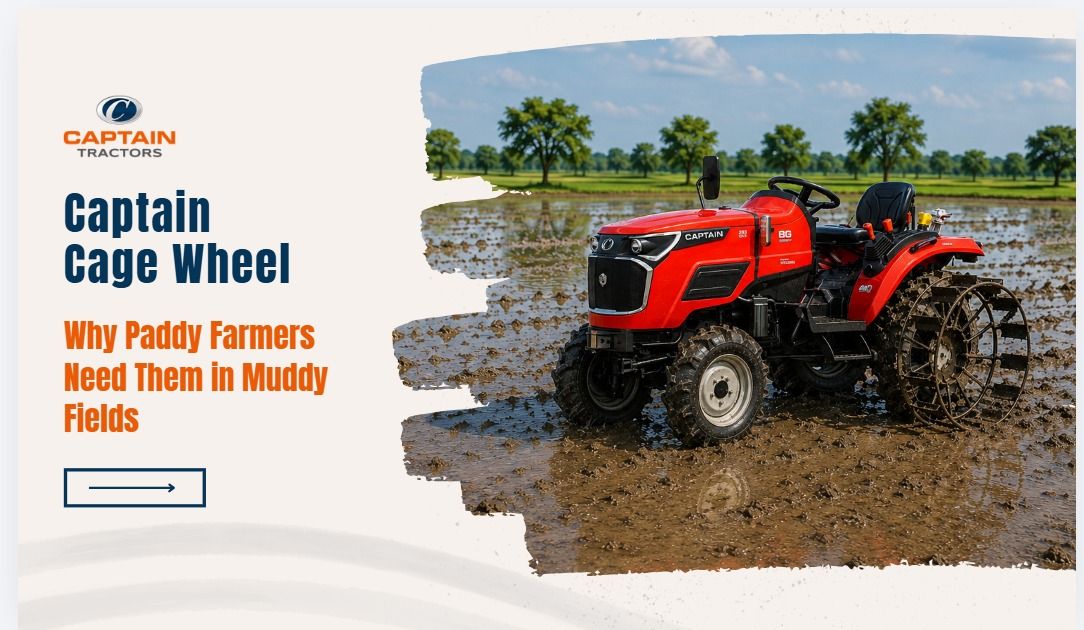
A cage wheel is a steel wheel attachment for tractors. It fits over the rear tyre or replaces it. It is made of steel bars arranged in a round cage shape — that is why it is called a cage wheel.
These steel bars dig into soft, wet soil. This gives the tractor grip even in deep mud. Normal tyres sit on top of the mud and spin. Cage wheels push into the mud and hold.
The open cage design also lets mud and water pass through. This stops mud from building up inside the wheel, which is a common problem with solid tyres in paddy fields.
Cage wheels are tractor attachments. They do not do field work on their own. They work with other tractor implements — like rotavators, MB ploughs, and puddlers — and help the tractor run those implements properly in wet conditions.
Why Normal Tyres Do Not Work in Paddy Fields
On hard ground, a tyre presses into the soil and gets grip. In a flooded paddy field, the soil is soft and wet — almost like thick mud. A normal tyre just pushes the mud away. There is nothing solid to grip. So the tyre spins.
The more the tyre spins, the worse it gets. Spinning churns the soil into liquid mud. The tractor starts to sink. It digs itself deeper with every spin.
Bigger, heavier tractors have this problem more. More weight means the tractor sinks faster in soft ground. This is why mini tractor implements like cage wheels are very useful for small farm holders. A lighter compact tractor with cage wheels can work better in a paddy field than a heavy tractor running on normal tyres.
Which Tractors Cage Wheels Fit
Cage wheels are made across different HP ranges, tractor types, and drive configurations, so farmers can choose the right fit for their machine and field size.
By HP range — Cage wheels are available for low-HP mini tractors used on small paddy plots, as well as mid-range tractors used on larger holdings. The correct HP match matters, since an undersized cage wheel will not carry the tractor's weight properly in mud, and an oversized one adds unnecessary strain.
Mini tractors — Compact and mini tractors are common in paddy-growing regions with small, fragmented landholdings. Cage wheels let these lighter machines get the traction of a much heavier tractor, without the sinking risk that comes with extra weight.
Compact tractors — For slightly larger paddy operations, compact tractors fitted with cage wheels handle bigger plots and tougher puddling work while still staying light enough to avoid getting stuck.
2WD tractors — On a 2WD tractor, all the pulling grip comes from the rear wheels. Cage wheels fitted here are what let a 2WD tractor work confidently in flooded soil that would otherwise stop it.
4WD tractors — On a 4WD tractor, the front tyres already add some grip. Cage wheels on the rear axle work alongside the front wheels, giving the tractor traction at all four corners for the wettest, softest fields.
Where Cage Wheels Are Used
Puddling for paddy is the main use. Puddling means ploughing a flooded field — usually with 5 to 10 cm of water — to make the soil soft and ready for planting rice seedlings. This whole process happens in wet, muddy conditions. Normal tyres fail here. Cage wheels work well. To learn more about puddling and how it is done, see the Captain Tractors Kharif season farming guide.
Wet and flooded fields — any field work in flooded or very wet soil needs cage wheels. This includes fields near canals, low-lying fields that hold water after rain, and fields flooded on purpose for soil preparation.
Heavy soil after rain — even without standing water, some soils get very soft and slippery after heavy rain. Black cotton soil and clay soil absorb a lot of water and become like mud. Cage wheels help here too.
Uneven or sloped fields in wet conditions — wet soil on a slope can cause the tractor to slide sideways. The steel bars of a cage wheel grip the soil and keep the tractor stable. This is safer for the farmer and better for the field.
Crop-wise Applications of Cage Wheels
Paddy is the main crop associated with cage wheels, but the wet-field problem is not unique to rice alone. Any crop grown in flooded or waterlogged conditions benefits from the same traction.
Rice — Rice is grown in standing water for most of its early growth stage, which makes cage wheels essential from puddling right through to field preparation between crop cycles.
Wetland vegetables — Vegetables grown in low-lying, moisture-retentive plots, often near water sources, face the same soft-soil conditions as paddy. Cage wheels help tractors move through these plots without damaging the crop beds.
Lotus farming — Lotus is grown in permanently flooded ponds and fields. Any tractor work around lotus farms — bunding, levelling, or field preparation — needs the same grip that cage wheels provide.
Water chestnut farming — Like lotus, water chestnut is grown in shallow standing water. Field preparation and maintenance work here runs into the same slipping and sinking problems that cage wheels are built to solve.
Canal-side farming — Fields next to canals stay damp or waterlogged for longer stretches of the season due to seepage and irrigation runoff. Cage wheels help tractors work these plots reliably, regardless of the specific crop grown.
Seasonal Usage of Cage Wheels
Cage wheels are not a year-round fitting for most farmers — they matter most during specific windows in the crop calendar.
Kharif season — The Kharif season, driven by the monsoon, is when most paddy and wetland cropping happens. This is when fields are flooded and cage wheels see the most use.
If you're preparing for monsoon cultivation, read our detailed Kharif season complete farming guide for Indian Farmers.
Monsoon preparation — Ahead of the monsoon, farmers fit cage wheels before the rains soften the soil, so the tractor is ready the moment fields start holding water.
Before puddling — Cage wheels should be fitted before puddling begins, while the tractor is still on dry ground. This ensures the tractor has full traction from the very first pass in the flooded field.
During transplantation — Once rice seedlings are being transplanted into puddled fields, any tractor movement around the field edges or bunds still needs the grip cage wheels provide, since the soil remains wet and soft through this stage.
Introducing the Captain Cage Wheel
Captain Tractors makes cage wheels built for Indian paddy farming. The Captain Cage Wheel is made from strong steel. It is built to handle season after season of wet field work without breaking down.
Specifications
Parameter | Details |
| Width | 460 mm |
| Height | 700 mm |
| Material | High-grade steel |
Key Features
Strong grip in muddy fields — The steel bars push into wet soil and keep the tractor moving. No spinning, no sinking.
Long-lasting build — Made from high-quality steel. Handles tough field conditions season after season.
Fits Captain tractors — Made to fit Captain's compact and mini tractor range. The fit is correct, so the wheel works the way it should.
Saves fuel — When normal tyres slip, the engine works harder and burns more fuel. Cage wheels reduce slipping. Less slipping means less fuel used for the same work.
Easy to maintain — No moving parts. No special servicing needed. Just fit and use.
How Cage Wheels Work With Other Implements
Cage wheels do not do field work on their own. But they help other tractor implements do their work better in wet conditions.
Take puddling with a rotavator. A rotavator churns and mixes wet paddy soil. But if the tractor's rear tyres are slipping in the flooded field, the rotavator cannot work properly. The tractor struggles. Work becomes slow. Fuel goes up. Add cage wheels to the same tractor and the wheels grip the soil. Now the rotavator can do its job without the tractor fighting the field.
The same goes for an MB plough used in wet soil. The plough needs the tractor to pull steadily. If the rear wheels are slipping, the plough cannot cut through the soil properly. Cage wheels give the rear wheels the grip needed to pull the plough cleanly.
Think of it this way — cage wheels are what make every other wetland implement actually work.
For farmers planning paddy season field work, look at the full range of tractor implements available. Cage wheels are the first thing to fit before starting any wet field operation.
Common Questions About Cage Wheels
Do cage wheels damage the paddy field? No. The steel bars spread the tractor's weight across many points instead of two solid tyre surfaces. This actually causes less damage to the soil than normal tyres in wet fields. The open cage frame also moves through soft soil without packing it into a hard layer.
Can cage wheels be used on 2WD and 4WD tractors? Yes. Cage wheels fit on the rear axle and work with both types. On a 4WD tractor, the front tyres also help with grip, while the cage wheels handle traction at the back.
When should cage wheels be fitted — before or after flooding the field? Always before. Fit the cage wheels while the tractor is still on dry ground. Changing wheels in a flooded field is difficult and not safe.
Are cage wheels only for paddy fields? Paddy is the main use. But cage wheels help in any field that is very wet, soft, or waterlogged. Fields near canals, low-lying vegetable fields, and fields worked after heavy rain all benefit from cage wheels.
What is the tractor cage wheel price in India? Price depends on size and which tractor it fits. Captain Tractors offers cage wheels at good prices for Indian farmers. Check the latest price or send an enquiry on the Captain Cage Wheels product page.
Final Thoughts
Paddy farming is different from dry land farming. The soil is wet, soft, and muddy for large parts of the season. Normal tractor tyres are not made for this. They slip, sink, and slow everything down.
Cage wheels solve this. They are simple tractor attachments that make a big difference in wet field conditions. With cage wheels, the tractor grips the soil, moves steadily, and lets all the other implements do their job properly.
The Captain Cage Wheel is built for these conditions. For farmers using Captain's mini tractor range in paddy fields, it is one of the most useful additions for the season.
Loading...