October 6, 2026
Shifting Cultivation: What Is It and How Does It Work?
Long before tractors, tube wells, and hybrid seeds became part of modern farming, communities in India’s hills and forests developed their own ways of growing food. One of these traditional methods is shifting cultivation, a farming system that is still practiced in parts of Northeast India and other tropical regions around the world.
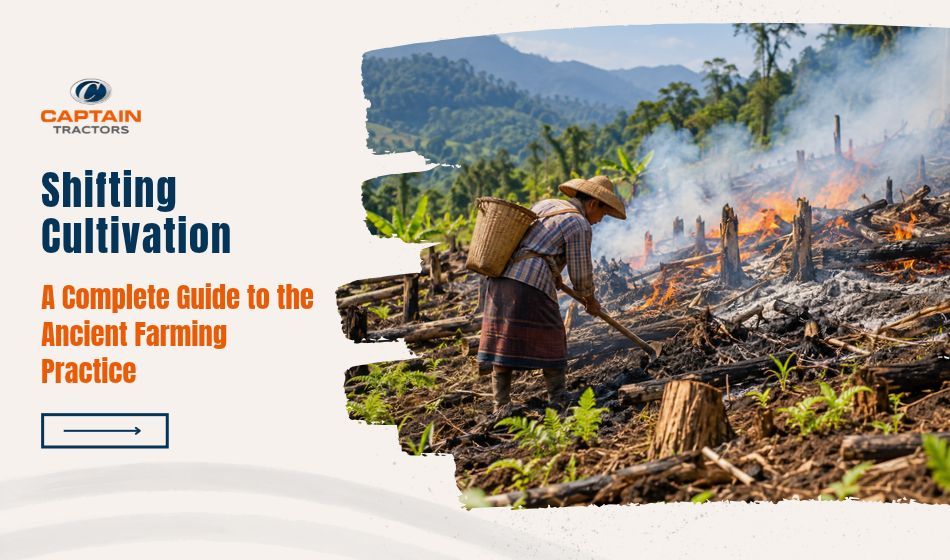
So, what is shifting cultivation? In simple terms, farmers cultivate a piece of land for a limited period and then leave it fallow while cultivation moves to another plot. The original plot is allowed to recover naturally before it is cultivated again.
This system is also known as swidden agriculture or slash and burn agriculture. In Northeast India, it is commonly called Jhum cultivation.
But how does shifting cultivation work? Where is it practiced in India, and why does it remain important today? Let’s look at the process, regions, benefits, challenges, and modern approaches to this traditional farming system.
What Is Shifting Cultivation?
Shifting cultivation follows a simple cycle: farm a piece of land for a limited period, leave it fallow so it can recover, and move cultivation to another plot.
The process generally includes these stages:
- Select a plot: Farmers choose a suitable area based on factors such as slope, vegetation, soil, and accessibility.
- Clear the land: Trees, shrubs, and other vegetation are cut and cleared.
- Burn the vegetation: In many traditional systems, the dried vegetation is burned. The resulting ash adds nutrients to the soil.
- Grow crops: Farmers sow and grow crops on the cleared plot for a limited period.
- Harvest the crops: Crops are harvested according to the local cropping cycle.
- Leave the land fallow: When productivity begins to decline, the plot is left uncultivated so vegetation and soil conditions can recover.
- Move to another plot: Cultivation shifts to another suitable area.
- Return later: Once the original plot has regenerated sufficiently, farmers can cultivate it again.
The fallow period is a key part of this system. Without enough time for natural regeneration, repeated cultivation can reduce soil fertility and increase pressure on the land.
How Does Shifting Cultivation Work?
The exact process varies between communities and regions, but the main stages remain similar.
1. Selecting the Plot
Farmers consider factors such as slope, existing vegetation, soil condition, water availability, and access before selecting a plot.
In hilly regions, slopes and areas with secondary vegetation may be used because flat agricultural land is limited.
2. Clearing the Vegetation
Trees, shrubs, grasses, and other vegetation are cleared using traditional tools. Farmers may leave selected trees standing when they provide useful products such as fruit, fuelwood, or other resources.
3. Burning the Vegetation
After the vegetation dries, it may be burned. The resulting ash can add nutrients such as potassium and calcium to the surface soil.
Burning also clears remaining vegetation and makes the plot easier to cultivate. However, the environmental effects depend greatly on how the land is managed and how long it remains fallow afterward.
4. Sowing and Cultivation
Seeds are often sown directly into the cleared soil without conventional ploughing.
Mixed cropping is common in Jhum farming, with several crops grown together on the same plot. Depending on the region, farmers may grow crops such as upland rice, maize, millets, pulses, vegetables, and colocasia.
5. Harvesting
Farmers harvest crops over one or more growing seasons depending on the local climate, crops, soil conditions, and farming practices.
There is no single fixed cultivation period for every shifting cultivation system.
6. The Fallow Period
After cultivation, the plot is left fallow. Natural vegetation gradually returns, organic matter builds up, and soil conditions can improve over time.
The length of the fallow period varies widely. In traditional systems with sufficient land, fallow periods could last many years or even decades.
When land becomes scarce, farmers may have to return to the same plot sooner. This can reduce the time available for natural recovery.
7. Returning to the Plot
Once the land has regenerated sufficiently, farmers can return to the plot and begin another cultivation cycle.
The success of this system depends heavily on maintaining a suitable balance between the cultivation period and the fallow period.
The Shifting Cultivation Cycle
The complete cycle can be summarised as:
Select land → Clear vegetation → Burn biomass → Sow crops → Cultivate and harvest → Leave land fallow → Vegetation regenerates → Return to the plot
There is no universal timeline for this cycle. Climate, soil type, available land, population density, crop choice, and local farming practices all influence how long each stage lasts.
Why Is It Called "Shifting" Cultivation?
The term comes from the movement of cultivation from one plot to another.
For example, a farmer may cultivate Plot A, then move to Plot B while Plot A remains fallow. Later, the farmer may move to Plot C before eventually returning to Plot A after its recovery period.
The farmland shifts, not necessarily the farmer's home.
This is an important distinction because shifting cultivation is a land use system rather than simply a practice of farmers moving from one place to another.
Shifting Cultivation vs. Slash and Burn Agriculture
Slash and burn agriculture and shifting cultivation are related, but they are not exactly the same.
Slash and burn describes the practice of cutting and burning vegetation to clear land.
Shifting cultivation describes the broader farming system, which includes clearing land, growing crops, leaving the plot fallow, and returning to it after a period of regeneration.
In simple terms, slash and burn is a land clearing technique, while shifting cultivation is the wider farming cycle.
Where Is Shifting Cultivation Practiced?
Shifting cultivation has been practiced for generations across tropical regions of the world, including parts of Southeast Asia, Africa, and South America.
Different regions have their own names and variations. Examples include Milpa in parts of Central America, Chena in Sri Lanka, Kaingin in the Philippines, and Ladang in parts of Southeast Asia.
In India, shifting cultivation is strongly associated with the Northeast, where it is commonly known as Jhum cultivation.
It has traditionally been practiced in states including:
- Assam
- Nagaland
- Mizoram
- Meghalaya
- Arunachal Pradesh
- Manipur
- Tripura
Similar forms of shifting cultivation have also existed in parts of Odisha, Jharkhand, and Chhattisgarh, as well as some hilly areas in southern India.
The Northeast remains the region where Jhum cultivation has particularly strong agricultural, cultural, and livelihood connections.
How Can Compact Tractors Support Shifting Cultivation?
Shifting cultivation is traditionally carried out using hand tools, particularly in hilly areas where large agricultural machines may not be practical.
However, where the terrain, plot layout, and access conditions allow, a compact tractor can support selected farm operations around a Jhum based farming system.
A small tractor can assist with tasks such as:
- Soil preparation
- Intercultivation
- Weed management
- Transporting farm inputs
- Moving harvested crops
- Other suitable field and transport operations
The right implement can also reduce manual labour for operations where tractor access is practical.
For farmers working on relatively accessible plots, Captain Tractors' compact and mini tractor range can be considered according to the required horsepower, tractor size, terrain, and type of work.
Compact tractors can be particularly useful where working space is limited and larger machines may be difficult to manoeuvre.
However, tractor use is not suitable for every shifting cultivation plot. Steep slopes, uneven ground, wet soil, narrow access routes, and difficult terrain require careful assessment before using machinery.
The right tractor implements can also reduce manual labour for operations where tractor access is practical. Depending on the field task, suitable implements can support soil preparation, intercultivation, weed management, and other farm operations.
The practical approach is to use mechanization where it fits the land and operation, while continuing to consider soil conservation, agroforestry, and other sustainable farming practices.
Jhum Cultivation in Northeast India
For many communities in Northeast India, Jhum is more than a farming method. It is connected to food production, local resources, traditional knowledge, and cultural practices passed down through generations.
Describing Jhum simply as an outdated farming method does not capture its importance to communities that continue to depend on it.
However, Jhum farming has changed over time. Population growth, reduced land availability, and other pressures have shortened fallow periods in some areas.
When farmers have less land available for rotation, they may have to return to a plot sooner. A shorter fallow period gives vegetation and soil less time to recover, which can increase concerns about soil fertility, erosion, and forest regeneration.
What Crops Are Grown in Shifting Cultivation?
Crop selection varies by region and local farming traditions.
Common crops can include:
- Upland rice
- Maize
- Millets
- Pulses
- Vegetables
- Colocasia and other tubers
- Oilseeds
Mixed cropping is common in Jhum farming. Farmers may grow several crops together rather than depending on a single crop.
This can provide a more diverse harvest and reduce the impact of poor performance in one particular crop.
Why Do Farmers Practice Shifting Cultivation?
Farmers continue to practice shifting cultivation for several practical and cultural reasons:
- Suitability for hilly land: It can be adapted to terrain where conventional farming systems may be difficult.
- Use of local resources: Traditional systems can make use of locally available vegetation, labour, and farming knowledge.
- Crop diversity: Several crops can be grown together on the same plot.
- Traditional knowledge: Communities have developed knowledge of local soils, crops, weather, and seasonal conditions.
- Food production: Jhum continues to provide food and livelihood support for many farming communities.
Advantages of Shifting Cultivation
When the land is given sufficient time to recover, shifting cultivation can offer several benefits:
- Crop diversity: Mixed cropping allows farmers to produce several types of food from the same plot.
- Limited external inputs: Traditional systems can rely heavily on local resources rather than extensive purchased inputs.
- Adaptation to difficult terrain: The system has evolved in regions where flat agricultural land may be limited.
- Natural regeneration: A sufficiently long fallow period allows vegetation to return and soil conditions to improve.
- Cultural value: Jhum farming remains closely connected to the traditions and livelihoods of several communities.
Disadvantages and Challenges of Shifting Cultivation
The main challenges arise when the natural cycle is disrupted, particularly when fallow periods become too short.
- Shortened fallow periods: Limited land availability can force farmers to cultivate plots again before they have fully recovered.
- Soil erosion: Cultivation on slopes can increase erosion if adequate soil conservation measures are not used.
- Declining soil fertility: Repeated cultivation with insufficient recovery time can reduce soil fertility.
- Pressure on forest vegetation: Frequent clearing can make it harder for vegetation to regenerate fully.
- Lower productivity: Declining soil quality can eventually affect crop yields.
Environmental Impact of Shifting Cultivation
The environmental impact of shifting cultivation depends largely on how the system is managed.
When fallow periods are long enough, vegetation has time to regenerate and soil organic matter can recover. The same plot can then be cultivated again as part of a longer cycle.
However, when farmers have to return after only a short fallow period, natural recovery may be incomplete.
This can increase the risk of:
- Soil erosion
- Nutrient loss
- Reduced soil fertility
- Reduced vegetation recovery
- Forest degradation
Therefore, it is important to distinguish between traditional shifting cultivation with sufficient fallow periods and shortened cycles caused by increasing land pressure.
Is Shifting Cultivation Sustainable?
The sustainability of shifting cultivation depends largely on the balance between the cultivated period and the fallow period.
When enough land is available to maintain a sufficiently long fallow cycle, vegetation and soil conditions can recover before the plot is cultivated again.
When land availability is limited, farmers may have to shorten the fallow period. Repeated cultivation before the land has recovered can reduce soil quality and crop productivity over time.
So, shifting cultivation cannot simply be described as either sustainable or unsustainable. Its sustainability depends on local conditions, land availability, fallow duration, farming practices, and how the land is managed.
Modern Approaches to Improve Shifting Cultivation
Rather than treating shifting cultivation as a system that must always be replaced, researchers and government agencies have explored approaches that can improve productivity while reducing pressure on land.
Some approaches include:
- Improved Jhum practices: Better planting methods, suitable crop varieties, and soil conservation techniques can improve productivity.
- Agroforestry: Combining trees with crops can provide additional products while supporting longer term land management.
- Terracing: Suitable terraces can help reduce water flow and soil erosion on slopes.
- Integrated farming: Combining crops with horticulture or livestock can diversify farm production.
- Soil and water conservation: Practices such as mulching, contour measures, and water harvesting can help retain soil and moisture.
The aim is to retain useful aspects of traditional farming knowledge while reducing the problems associated with shortened fallow periods and repeated land clearing.
Shifting Cultivation vs. Subsistence Farming
Subsistence farming and shifting cultivation describe different aspects of farming.
Subsistence farming refers mainly to the purpose of production, where farmers grow crops primarily for household consumption.
Shifting cultivation refers to the way farmland is managed, with cultivation moving between plots while previously cultivated land is left fallow.
A farmer can therefore practice shifting cultivation primarily for subsistence.
In simple terms, subsistence farming explains why crops are grown, while shifting cultivation explains how the land is managed.
Conclusion
Shifting cultivation is not simply a farming method from the past. It remains part of agricultural life in several hill regions of India, particularly in the Northeast, where it is widely known as Jhum cultivation.
The system works best when farmers have enough land to maintain suitable fallow periods between cultivation cycles. During this time, vegetation can regenerate and soil conditions can recover.
The challenge arises when land availability decreases and farmers have to return to the same plots too quickly. Shorter fallow periods can contribute to soil fertility loss, erosion, reduced vegetation recovery, and declining crop productivity.
The answer is not necessarily to replace shifting cultivation completely. Better soil management, suitable conservation practices, agroforestry, and improved farming techniques can help communities manage the system more sustainably while respecting its agricultural and cultural importance.
Frequently Asked Questions
1. What is shifting cultivation in simple words?
Shifting cultivation is a farming method in which farmers cultivate one plot for a limited period, leave it fallow for recovery, and move cultivation to another plot before eventually returning to the original land.
2. What is another name for shifting cultivation?
Shifting cultivation is also known as swidden agriculture. Slash and burn agriculture is a related term that describes the clearing and burning of vegetation. In Northeast India, the practice is commonly known as Jhum cultivation.
3. What is Jhum cultivation?
Jhum cultivation is the regional term commonly used for shifting cultivation in several parts of Northeast India, including states such as Nagaland, Mizoram, Meghalaya, Manipur, Tripura, Assam, and Arunachal Pradesh.
4. Which crops are grown in shifting cultivation?
Common crops include upland rice, maize, millets, pulses, vegetables, tubers such as colocasia, and oilseeds. Several crops may be grown together as part of mixed cropping.
5. Is shifting cultivation good or bad for the environment?
Its environmental impact depends on how the land is managed and how long the fallow period lasts. Longer fallow periods can allow vegetation and soil to recover, while repeated cultivation with short fallow periods can increase soil degradation and erosion.
6. Why is shifting cultivation still practiced in India?
It remains suited to certain hilly and forested environments and continues to provide food and livelihood support. It also has strong cultural and traditional importance for many communities in Northeast India.
Loading...