August 5, 2026
Fertilizer Broadcaster for Modern Farming: Complete Guide for Indian Farmers
Introduction
Most farmers who apply fertilizer by hand know the problem. One part of the field gets too much. Another part gets too little. The crop comes up uneven. Some rows grow well. Others fall behind. By harvest time, that unevenness shows up in the yield.
Manual fertilizer spreading is slow too. On a medium-sized field, it can take hours — hours that could be spent on other work.
A fertilizer broadcaster solves both problems. It spreads fertilizer evenly across the field, covers large areas quickly, and does it all from the tractor seat. This guide explains what a fertilizer broadcaster is, how it works, and what features to look for before buying one.
What Is a Fertilizer Broadcaster?
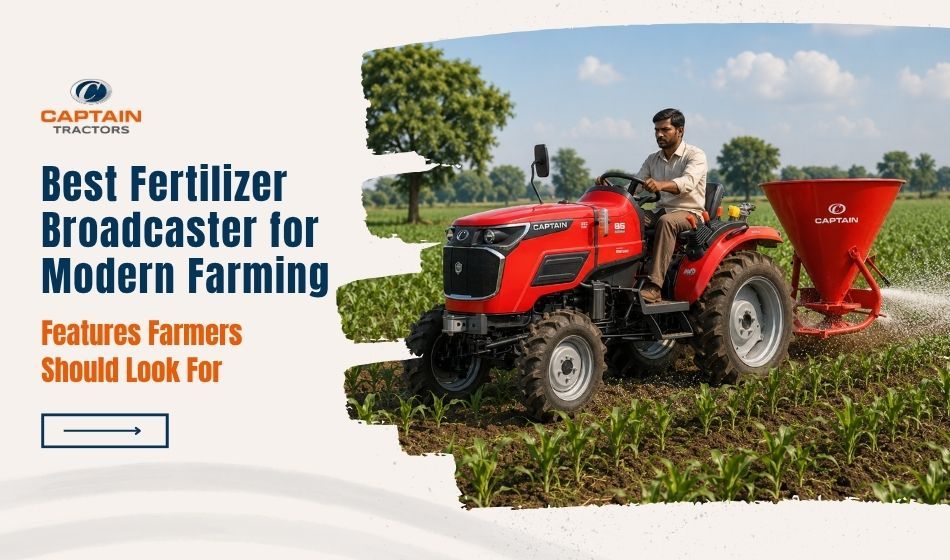
A fertilizer broadcaster — also called a fertilizer spreader machine — is a tractor-mounted implement that spreads fertilizer across a field as the tractor moves. It uses a spinning disc to throw fertilizer outward in a wide arc, covering a large area in each pass.
It is one of the most useful tractor implements for crop care. It connects to the tractor's three-point linkage and is powered by the tractor's PTO (Power Take-Off). As the tractor moves forward, the spinning disc keeps throwing fertilizer evenly across the field.
A good fertilizer broadcaster does not just spread fertilizer. It spreads it evenly. That is the difference between a crop that grows uniformly and one that shows patches all season.
What Is the Difference Between a Broadcaster and a Seed Drill?
This is a common question. Both deal with spreading something across a field — but they work very differently.
A fertilizer broadcaster spreads material across the surface in a wide arc. It covers more area per pass. It is best for fertilizer, micronutrients, soil conditioners, and certain seeds like grass, pulses, and oilseeds that can be surface-broadcast.
A seed drill places seeds at a specific depth in the soil, in rows, with precise spacing. It is used when accurate seed placement matters — like for wheat, maize, or soybean.
For fertilizer application before or after sowing, a broadcaster is the right tool. For accurate seed placement, a seed drill is the right tool. The two serve different purposes.
Why Uneven Fertilizer Application Is a Real Problem
When fertilizer is spread by hand, it is almost impossible to keep it even. The person spreading it walks at different speeds, throws different amounts, and gets tired. The result is that some plants get more fertilizer than they need. Others get less. This imbalance shows in the crop all season — uneven growth, patchy canopy, and lower overall yield.
There is also the problem of wastage. Over-application in some areas is money spent for no return. Under-application in other areas means those plants never reach their potential.
A fertilizer broadcaster removes this guesswork. The spinning disc spreads material at a fixed rate across a fixed width. Every part of the field gets the same amount. The result is more uniform growth, less waste, and better use of the fertilizer budget.
Features to Look For in a Fertilizer Broadcaster
Not all broadcasters are the same. Here are the key features that matter when choosing one.
1. Adjustable Flow Control
Different crops need different amounts of fertilizer. Different fertilizers have different densities — a light granule spreads differently than a heavy one. A good broadcaster lets you adjust how much material flows out with each pass. Without this, you are locked into one setting for every situation, which rarely works well.
Look for a broadcaster with a simple, easy-to-adjust flow gate. You should be able to change the setting quickly without tools.
2. Spinning Disc Quality
The disc is what does the spreading. A well-made disc spins at a consistent speed and throws material evenly in all directions. A poorly made disc creates uneven spread patterns — some areas get more, some get less.
The disc should be made from strong, rust-resistant material. It takes a lot of wear from granular fertilizers, season after season. A cheap disc will wear unevenly and start spreading unevenly before long.
3. Hopper Size and Material
The hopper is the container that holds the fertilizer. A larger hopper means fewer stops to refill — which matters on a large field. But the material also matters. Fertilizers and soil conditioners are often corrosive. A hopper made from rust-resistant or plastic material will last far longer than a plain metal one.
Think about how much area you need to cover in one go and choose hopper size accordingly.
4. PTO Compatibility
Most tractor-mounted fertilizer broadcasters run off the tractor's PTO. Make sure the broadcaster is compatible with your tractor's PTO speed and shaft size. A broadcaster designed for a large tractor may not work well with a mini tractor — and vice versa.
This is especially important for farmers using compact tractors. Look specifically for mini tractor implements that are designed for the lower HP range, so the broadcaster performs correctly without putting too much load on the engine.
5. Spreading Width
Different broadcasters cover different widths per pass. A wider spread means fewer passes across the field — which saves time and fuel. But a wider spread can also mean less accuracy at the edges.
For small fields or irregularly shaped plots, a moderate spread width gives better control. For large, open fields, a wider spread is more efficient.
6. Build Quality and Maintenance
A fertilizer broadcaster is used every season, sometimes several times a season. It needs to hold up. Look for heavy-duty frame construction, rust-resistant components, and a simple design with as few moving parts as possible.
Simple design means easier maintenance. A broadcaster with fewer parts is easier to clean after use and easier to fix if something goes wrong.
7. Easy Mounting and Dismounting
The broadcaster should fit easily onto the tractor's three-point linkage and come off just as easily. If mounting takes a long time, farmers tend to skip using the implement for smaller jobs — which defeats the purpose of having it.
Good tractor attachments are designed so one person can mount and dismount them without needing extra help.
Introducing the Captain Fertilizer Broadcaster
Captain Tractors, one of the trusted tractor manufacturers in India, makes a range of tractor implements designed specifically for Indian farming conditions. The Captain Fertilizer Broadcaster is built for small and medium farms with a design that works well with Captain's mini and compact tractor lineup.
Specifications
Parameter | Details |
| Width | 1180 mm |
| Height | 1130 mm |
| Approx. Weight | 63 kg
|
Why Farmers Choose Captain Fertilizer Broadcasters
- Designed for Indian field conditions
- Compatible with Captain mini and compact tractors
- Durable construction for long service life
- Uniform fertilizer distribution
- Low maintenance design
- Supported by Captain's nationwide dealer network
- Backed by manufacturer warranty (mention actual warranty period if applicable)
Easy Dealer Support Across India
Captain Tractors has an extensive dealer network that helps farmers with product demonstrations, spare parts, and after-sales support. Contact your nearest authorised dealer to choose the right fertilizer broadcaster for your tractor and farming requirements.
Built by an Experienced Tractor Manufacturer
Captain Tractors has decades of experience designing compact tractors and farm implements for Indian agriculture. Every implement is developed to work efficiently with Captain tractors while meeting the practical needs of small and medium-sized farms.
What Makes It a Good Fit for Indian Farms
Even spreading — The spinning disc design ensures fertilizer is distributed uniformly across the field. Every plant in the field gets the same nutrition, not just the ones in the middle of your throw.
Adjustable flow control — The flow rate can be set based on the crop and the fertilizer being used. One adjustment handles the difference between light micronutrient powders and heavier granular fertilizers.
Strong, durable build — Made from materials that handle the wear of regular seasonal use. Built to last more than one or two seasons.
Works as a seed broadcaster too — The same implement can broadcast seeds like grasses, pulses, and oilseeds. This makes it a flexible farm implement that earns its place beyond just fertilizer season.
Mini tractor compatible — Designed to work with Captain's compact tractor range without putting unnecessary load on the engine. Fuel-efficient and easy on the tractor.
Low maintenance — Simple design with rust-resistant parts. Easy to clean after use, easy to store between seasons.
When to Use a Fertilizer Broadcaster
Before sowing — Basal fertilizer application before the crop goes in is one of the most common uses. After a rotavator has prepared the seedbed, a broadcaster applies fertilizer evenly before sowing begins.
Top dressing — Applying fertilizer to a standing crop — usually nitrogen — is called top dressing. A broadcaster can do this quickly across large fields without damaging the crop, unlike manual spreading which requires walking through the standing crop.
Seed broadcasting — Certain crops — grasses, green manures, pulses, oilseeds — can be surface-broadcast rather than drilled. A broadcaster handles this efficiently, covering large areas in a short time.
Soil conditioner application — Lime, gypsum, and other soil conditioners are often broadcast across the field before tillage. A broadcaster makes this fast and even. For more on how soil nutrient management and fertilizer application work together, see the Captain Tractors Soil Health Card guide.
Common Mistakes Farmers Make With Fertilizer Broadcasting
Not calibrating before use — Every fertilizer has a different flow rate. If you do not check and set the flow rate before starting, you will either over-apply or under-apply. Take five minutes to calibrate before the first pass. It saves money and improves results.
Overlapping passes too much — Overlapping is needed to avoid missed strips, but too much overlap means some areas get double the fertilizer. Keep passes at consistent spacing. Most broadcasters have a recommended overlap distance — follow it.
Spreading in wind — A broadcaster throws material through the air. In strong wind, that material drifts. Apply fertilizer in calm conditions, or early morning when wind is low.
Not cleaning after use — Fertilizer left in the hopper and on the disc is corrosive. It eats into metal parts and reduces the life of the implement. Clean the broadcaster after every use. It takes ten minutes and adds seasons to the life of the machine.
Using the wrong setting for different fertilizers — The flow rate that works for one fertilizer may be too high or too low for another. Always re-check and adjust when switching between fertilizer types.
Frequently Asked Questions
What is a fertilizer broadcaster used for? A fertilizer broadcaster spreads fertilizer, seeds, and soil nutrients evenly across the field as the tractor moves. It is used for basal application, top dressing, seed broadcasting, and applying soil conditioners.
Can a fertilizer broadcaster spread seeds? Yes. Many broadcasters including the Captain model can spread seeds like grasses, pulses, and oilseeds. For crops that need accurate depth and spacing, a seed drill is still the better choice.
What is the fertilizer broadcaster price in India? Price depends on the brand, capacity, and build quality. Captain Tractors offers competitively priced, durable broadcasters suited for Indian farm conditions. Visit the Captain Fertilizer Broadcaster for current pricing or to raise an enquiry.
Is a fertilizer broadcaster suitable for a mini tractor? Yes — as long as the broadcaster is designed for the lower HP range. The Captain Fertilizer Broadcaster is built specifically for Captain's mini and compact tractor lineup, so it works correctly without overloading the engine.
How do I clean a fertilizer broadcaster after use? Remove any leftover material from the hopper. Rinse the hopper, disc, and frame with water. Let it dry completely before storing. Do not leave fertilizer sitting in the hopper between uses.
What is the difference between a centrifugal broadcaster and a drop spreader? A centrifugal broadcaster (like the Captain model) uses a spinning disc to throw material in a wide arc — covering more area per pass. A drop spreader drops material straight down in a narrow band. Broadcasters are faster for large fields. Drop spreaders are more precise for narrow rows.
Final Thoughts
Fertilizer application is one of the most direct investments a farmer makes in the crop. But if that fertilizer is not spread evenly, a large part of that investment does not reach the crop — it either goes to waste or creates imbalance in the field.
A good fertilizer broadcaster turns fertilizer application from a slow, uneven manual job into a fast, precise, tractor-mounted operation. The right features — adjustable flow, quality disc, compatible with your tractor, strong build — make the difference between a broadcaster that works well for seasons and one that disappoints.
The Captain Fertilizer Broadcaster is designed for Indian farm conditions and built to work with Captain's compact tractor range. For farmers looking at the full range of tractor implements for crop care and field preparation, it is a straightforward addition that pays for itself across seasons.
Loading...