October 22, 2026
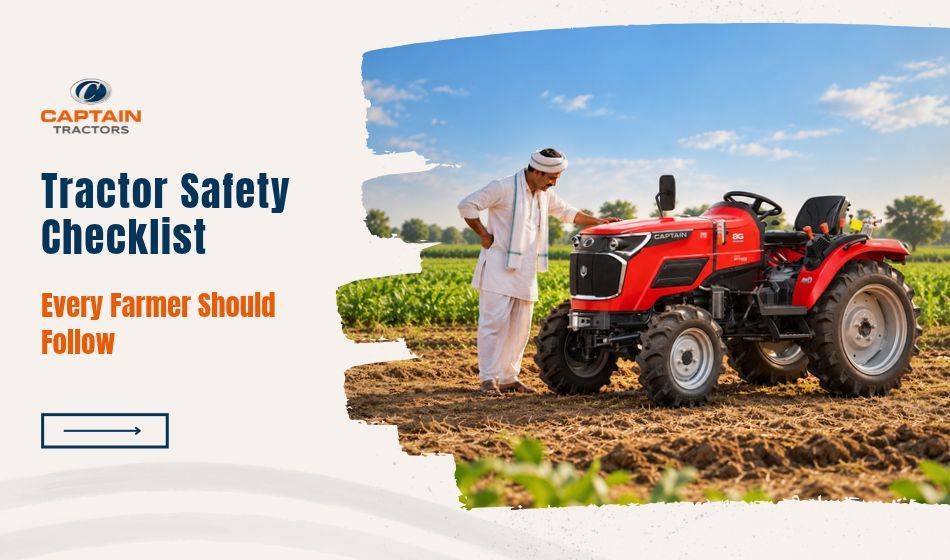
Tractor Safety Checklist Every Farmer Should Follow
A tractor is an important part of everyday farm work, helping farmers save time and handle different tasks more efficiently. But working with heavy machinery also comes with risks. A quick check before starting and a few safety habits while operating the tractor can help prevent accidents and keep everyone on the farm safe.
In this guide, we cover the essential tractor safety checks to follow before starting the engine, during fieldwork and after finishing the job. Whether you are an experienced farmer or a new tractor owner, these simple steps can help you work with greater confidence and care.
Why Tractor Safety Matters on Every Farm
Most tractor accidents are not freak events. They happen in the same few ways again and again.
- Rollovers: The tractor tips over on a slope, near a ditch or during a sharp turn.
- Falls: A person slips while climbing on or off the tractor.
- Moving parts: Hands, clothes or feet get caught in a rotating shaft or belt.
- Collisions: The tractor hits a person, an animal, a vehicle or a wall.
Each of these can be prevented. Most of them are prevented by habits that take only a few minutes. That is why a daily tractor safety routine is worth more than any single piece of equipment.
Every tractor model has its own operating instructions and safety requirements. Keep your tractor’s operator manual handy and read the safety guidelines before use.
The tips in this article offer general guidance, but always follow the instructions provided in your tractor’s manual.
Tractor Safety Checklist Before Starting the Engine
Spend five minutes on a walk-around before every use. It is the best habit in farm tractor safety.
- Fluids: Check engine oil, coolant and fuel as your manual says.
- Tyres: Look for cuts and bulges. Check the air pressure.
- Brakes and steering: Make sure both work properly and feel normal.
- Leaks and loose parts: Look under the tractor for oil or fuel leaks. Check for loose bolts and damaged parts.
- Lights, indicators and mirrors: Check that they work and are clean.
- Hitch and hydraulic connections: Look at the hitch, pins and hoses. They should be secure and not worn.
- Guards and shields: Make sure all guards are fitted on the implement and the tractor.
- Safety equipment: If your tractor has a rollover protective structure (ROPS) and a seat belt, check both.
- Operator area: Keep the steps, pedals and floor clean. Mud and oil make feet slip.
- Surroundings: Look around for children, animals, people and obstacles before you move.
If you find a problem you cannot fix yourself, do not use the tractor. Call a trained technician. Simple checks like fluids and tyre pressure are fine for you to do. Brake, steering and hydraulic repairs are for trained people.
Safety Rules While Operating a Tractor
Most accidents happen while the tractor is working. These rules keep you safe in the field.
- Start from the operator's seat. Never start the engine while standing on the ground next to the tractor.
- Wear the right clothes. Use strong footwear with a good grip. Avoid loose clothes, long scarves or open ends that can get caught in moving parts.
- No extra riders. Do not carry people on the tractor unless it has a proper, approved passenger seat. Mudguards, drawbars and implements are not seats.
- Keep children and bystanders away. Children should never play near a working tractor. Keep them out of the work area.
- Drive at a safe speed. Slow down on rough ground and before turns.
- Avoid sudden turns. A fast turn is one of the easiest ways to lose control.
- Mount and dismount carefully. Face the tractor, use the steps and keep three points of contact.
- Never get off a moving tractor. Stop, put it in park or neutral, apply the brake, switch off and then get down.
Avoid operating the tractor when you feel tired. Tiredness can slow your reactions and make it harder to control the tractor safely. Take regular breaks, drink enough water and get proper rest before returning to work.
How to Prevent Tractor Rollovers
A rollover is among the most dangerous tractor accidents. It can happen very fast. Knowing the causes helps you avoid them.
Common causes of rollovers:
- Driving on steep or uneven slopes
- Taking sharp turns at speed
- Driving too close to ditches, canals or soft edges
- Carrying a heavy or uneven load
- Pulling a load from the wrong point
What you can do:
- Stay away from steep slopes. Check your manual for slope limits.
- Drive straight up and down a slope instead of across it, where your manual advises it.
- Keep a safe distance from ditches and soft ground.
- Keep loads low and balanced.
- Attach loads only to the designated hitch point on the tractor. Pulling from a high or wrong point can make the front lift and the tractor flip backwards.
- If the tractor gets stuck, do not force it. Reverse out slowly or ask for help.
If your tractor has ROPS (Rollover Protective Structure) and a seat belt, use the belt every time. A ROPS with a seat belt gives the operator real protection in an overturn. But it does not stop a rollover from happening. Safe driving still comes first.
Tractor Safety and Compact Tractors: How We Think About It at Captain Tractors
Since 1994, we at Captain Tractors have been building compact and mini tractors at our base in Gujarat. Today our tractors work in orchards, vegetable farms and small and medium fields across India. Our network of 175+ dealers supports farmers here, and our tractors reach 80+ countries.
In all these years, one thing has stayed the same. A tractor is only as safe as the way it is used. We always ask farmers to check their tractor before every use, follow the service schedule in the manual and use the right implement for each job.
A lighter, compact tractor is easier to handle in narrow rows and tight spaces. But it still needs the same care. A smaller machine is not a safe-by-default machine. Slopes, loose loads and moving parts are just as risky on a 12 HP tractor as on a bigger one.
If you are choosing a tractor for a small farm, our Captain Little Master 120 is a lightweight 12 HP model. Whichever model you choose, read its operator manual first and ask your dealer to show you the safety features.
One pattern we see often: Many accidents on small farms happen in the first season after a new tractor is bought. The farmer is excited, the work is rushed and the manual stays in the box.
Farmers who read the manual, learn the controls and follow the dealer’s demo are better prepared for safe tractor use. Spending that one hour learning the tractor properly can help keep them safe season after season.
Tractor and Implement Safety
Most tractor safety problems begin where the tractor meets the implement. This is the point where hands, clothes and tools get caught.
- Match the implement to the tractor. Do not use an implement that is too heavy or too large for your tractor's power and weight.
- Secure the hitch pins and connections. Check them again after the first few minutes of work.
- Keep PTO shields in place. The power take-off (PTO) shaft spins fast. Never run it without its shield.
- Stop before you clear blockages. Switch off the engine, disengage the PTO and wait until all moving parts stop. Only then clean or adjust anything.
- Never touch a spinning shaft. Do not step over or reach across a rotating PTO shaft.
- Lower the implement. Before you leave the seat, put the implement on the ground.
- Never work under a raised implement. Hydraulics can fail. Support raised equipment with proper stands.
At Captain Tractors, we make tractor implements that are designed to work with our compact tractors, such as rotavators, cultivators, ploughs and sprayers. Whatever implement you use, always follow the fitting steps in its manual and make sure it suits your tractor model.
Safe vs Unsafe Habits at a Glance
Task | Safe habit | Unsafe habit |
| Starting | Start from the operator's seat | Starting from the ground |
| Clearing a blockage | Engine off, PTO off, parts stopped | Clearing it while the PTO spins |
| Raised implement | Lowered or supported on stands | Working under hydraulics alone |
| Pulling a load | Use the designated hitch point | Tying the load to a high point |
| Passengers | Only on an approved seat | Riders on the mudguard or drawbar |
| Slopes | Slow speed, straight line | Fast, sharp turns on a slope |
Tractor Safety on Roads
Many farmers use the tractor on public roads to reach the field or the market. Roads bring extra risk, because other vehicles are fast.
- Check lights and indicators. Make sure they work, especially in the early morning, evening and at night.
- Check your brakes. If a trailer is attached, check that its brakes and connection are working properly.
- Drive slowly. A loaded tractor takes longer to stop.
- Secure your load. Tie it down properly and keep it balanced. Do not let it hang over the sides.
- Do not overload the trailer. An overloaded trailer is hard to control and hard to stop.
- Keep people off the load. Nobody should sit on top of a trailer load.
- Follow traffic rules. Check the Indian traffic rules and local requirements for agricultural tractors and trailers. Do not assume the rules are the same everywhere.
For hauling, a well-built trailer matters. Our tractor trailer is built for carrying crops, manure and other loads. Whichever trailer you use, load it evenly and never beyond its limit.
Safe Tractor Maintenance and Refuelling
Maintenance keeps your tractor reliable. But many injuries happen during servicing, so it needs care too.
- Switch off the engine and remove the key before you start any repair or service.
- Let the engine cool down before you refuel. Never refuel a hot or running engine.
- Keep flames away. No smoking, no open fire and no mobile phone use near the fuel.
- Use a funnel to avoid spills, and wipe up any spill at once.
- Support raised parts safely. Use proper stands or blocks, not only the hydraulic lift.
- Let hot parts cool before touching the engine, silencer or radiator.
- Follow the service schedule in your manual for oil, filters and greasing.
- Keep a first-aid kit and a fire extinguisher where you store the tractor.
Tractor Safety Checklist for Daily Use
Save this checklist on your phone or print it and keep it near the tractor.
Check | What to verify |
| Fluids | Oil, coolant and fuel, as your manual says |
| Tyres | Condition and air pressure |
| Brakes and steering | Working properly |
| Lights and indicators | Working before any road travel |
| Leaks and loose parts | No leaks, no loose bolts, no damage |
| Hitch and implements | Pins, connections and guards secure |
| PTO | Shields fitted and not damaged |
| Operator area | Steps, pedals and controls clean |
| Surroundings | No children, animals, people or obstacles near |
| Safety equipment | ROPS and seat belt checked, where fitted |
Before you leave the tractor, also remember:
- Lower the implement to the ground
- Disengage the PTO
- Apply the brake
- Switch off the engine and remove the key
FAQs About Tractor Safety
What should farmers check before starting a tractor?
Check the fluids, tyres, brakes, steering, lights, hitch and guards. Look for leaks and loose parts. Then check that no people, children or animals are near. This takes about five minutes.
What are the most important tractor safety rules?
Start only from the operator's seat. Do not carry extra riders. Keep children away. Drive at a safe speed and avoid sudden turns. Keep all shields in place. Switch off the engine before you clear a blockage or do any service.
How can farmers prevent tractor rollovers?
Avoid steep slopes, ditches and sharp turns. Keep loads low and balanced. Hitch loads only at the designated hitch point. Use the seat belt if your tractor has a ROPS. Check your manual for slope limits.
How can you safely operate a tractor with implements?
Choose an implement that suits your tractor. Fit the hitch pins well. Keep PTO shields on. Switch off the engine and wait for all parts to stop before you clear or adjust anything. Lower the implement when you leave the seat.
What precautions should farmers take when driving a tractor on roads?
Check lights, indicators and brakes. Drive slowly. Secure the load and never overload the trailer. Keep people off the load. Follow the Indian traffic rules and any local requirements for tractors.
How often should a tractor be inspected for safety?
Do a quick walk-around check before every use. Follow the service schedule in your operator's manual for deeper checks. Get a trained technician to look at brakes, steering and hydraulics regularly.
Make Tractor Safety a Daily Habit
Tractor safety is not about fear. It is about a few small checks that become second nature. Check the tractor before you start. Work at a safe speed. Keep people away. Respect slopes, PTO shafts and raised implements. And always read your manual.
If you are planning to buy a tractor or want help choosing the right model and implements for your farm, explore the range of our tractors or visit Captain Tractors to find your nearest dealer.
Loading...