May 21, 2026
Tractor Loaders A Complete Guide for Farms
Tractor Loaders: A Complete Guide for Farms
Walk into any working farm and you'll find a loader doing a different job every few hours. Soil in the morning, feed by afternoon, clearing debris before sundown. Same machine, completely different work.
A tractor loader changes what your machine is actually capable of. Shifting soil, clearing land, moving feed, handling heavy loads across rough ground — the list gets long fast. The right loader turns a tractor into a full workstation.
So that's what this guide is really about. What a tractor loader is, what to check before you spend money on one, and why the Captain 8G tractor loader makes a lot of sense for small and mid-sized farms in India.
What is a Tractor Loader?
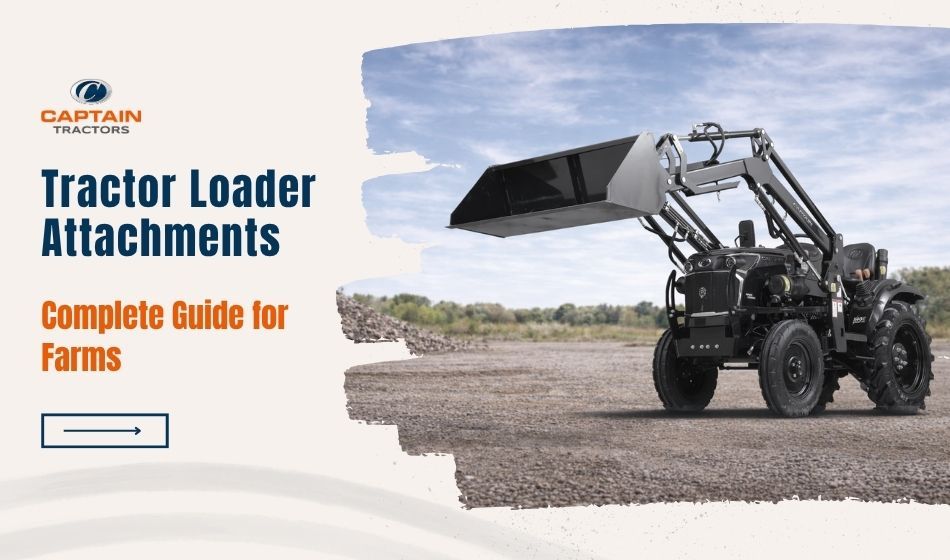
A tractor loader is a hydraulic lifting system mounted to the front of a tractor. It consists of two main arms (the boom), a hydraulic system that raises and lowers the arms, and a mounting frame that connects to the tractor chassis.
What most people call “the loader” is really just the arm. Whatever you clip onto the end; a bucket, forks, a grapple, a bale spear, that's what actually gets the work done. The loader is the arm. The attachment is the hand. Without the hand, the arm just waves around.
Worth knowing: loader attachments are not the same as rear implements like ploughs, rotavators or seed drills, which go on the 3-point hitch at the back. A loader is front-mounted and powered by the tractor’s hydraulic system.
What Can a Tractor Loader Actually Do?
What a loader can do day-to-day depends a lot on what's fitted to the front. But the core stuff looks something like this:
- Moving loose material — soil, sand, gravel, manure, compost
- Handling pallets, bags, and stacked feed inputs
- Clearing land — debris, rocks, branches, and storm waste
- Managing livestock operations — feed distribution, bedding, manure cleaning
- Construction and yard work — levelling ground, shifting materials on-site
The common thread? All of these used to require manual labour or a larger, more expensive machine. A loader brings that capability down to the farm level.
What to Look for Before Buying a Tractor Loader
Getting the wrong loader — or one that doesn’t fit your tractor — is an expensive mistake. Run through these before purchasing:
Lift Capacity
Every loader has a rated maximum lift. The attachment plus the material being carried must stay under that limit. Push past it and you're putting real stress on the frame, the hydraulics, and the tractor — none of which is cheap to fix.
Compatibility with Your Tractor
This is where many buyers go wrong. Most loaders on the market are designed for standard-sized or large tractors. Fitting one to a mini tractor often leads to poor balance, structural stress, or simply a machine that won’t couple properly.
Hydraulic Flow Requirements
Some advanced functions require hydraulic flow beyond the standard loader circuit. No right valve setup on your tractor? Those functions simply won't run until you sort that out first.
Steel Quality and Build
Cheap loaders use thin sheet metal that bends under real farm loads. Look for industrial-grade structural steel — the kind rated for heavy equipment, not light construction.
Ease of Operation
If changing attachments requires two people, a toolkit, and twenty minutes, you’ll stop switching them. Single-operator, tool-free attachment systems make a real difference to daily workflow.
Tractor HP Match
A heavier loader in demanding conditions needs enough engine power behind it. Match the loader to what your tractor can realistically handle day after day.
The Problem with Standard Loaders on Mini Tractors
Here’s the challenge most small farmers in India run into: most loaders on the market are built for larger machines. When you try fitting them onto mini tractors, you’re usually dealing with:
- Poor weight distribution that affects balance and stability
- Compatibility issues with the frame and coupler
- Hydraulic systems not matched to the smaller tractor’s output
- Oversized dimensions that don’t work in sheds, narrow paths, or tight spaces
The solution isn’t to “size down” a standard loader. It’s to engineer one specifically for mini tractors from the ground up.
Captain 8G Mini Tractor Loader: Built for the Job
Captain Tractors - the company behind India’s first mini tractor, founded in 1998 has developed what they describe as India’s first company-designed mini tractor loader. Not a modified import. Not a scaled-down version of something else. Designed specifically for mini tractors and Indian farm conditions.
It’s now in its 8th Generation, compatible with Captain 250/280 LS (2WD) models. Here’s what sets it apart:
- 500 KG Lift Capacity: Enough for real daily farm loads without pushing the tractor past its limits.
- S355 Steel Structure: This is industrial-grade steel, the stuff they use in heavy equipment, not the thin sheet metal that quietly buckles after one hard season and leaves you wondering what happened.
- Heavy Duty Hydraulic Cylinder: Lifts steadily, responds properly, no lag. The kind of thing you only notice when it's missing.
- High Pressure Metal Pipes: Rubber lines crack. Summer heat, rough ground, a bit of age and suddenly you've got a hydraulic problem in the middle of a working day. Metal pipes handle all of that a lot better.
- Multifunction Joystick: Lift, lower, tilt; one controller does it all. Most farmers figure it out within the first hour, no manual required.
- Flow Control for Speed Adjustment: Slower when you need precision, faster when you’re moving bulk. You control the pace.
- Shock Absorber: Absorbs impact when you hit a rut or stone with a loaded bucket, instead of letting that jerk run straight through the frame.
- Levelling Indication: Tells you when the bucket is sitting level while moving — saves you from tipping material halfway across the field.
- Easy Attach and Detach: One person can switch attachments without tools. Because changing setups mid-day shouldn’t be a two-person job.
Built for Dairy and Livestock Operations Too
In dairy and livestock farms, working in tight spaces is a daily challenge inside sheds, narrow alleys, and feeding areas. The 8G Loader’s compact design lets you move freely in these environments without disturbing animals.
Feed handling, manure cleaning, bedding, tasks that used to eat up half the morning now get done properly and quickly. And because soil compaction is low and the controls are smooth, the area stays cleaner and the animals aren't stressed by the machine moving around them.
How the Captain 8G Compares to a Standard Tractor Loader
| Category | Parameter | Standard Tractor Loader | Captain 8G Mini Loader |
| Dimensions | Machine size | Large | Compact |
| Entry width required | Wider | Narrow entry possible | |
| Turning radius | Medium | Very low | |
| Works in narrow spaces | Limited | Yes | |
| Indoor/shed operation | Difficult | Easy | |
| Operator visibility | Average | Excellent | |
| Compatibility | Soil compaction | High | Low |
| Surface damage risk | High | Very low | |
| Multi-utility applications | No (loading only) | High (quick attach/detach) | |
| Performance | Fuel consumption | High | Low |
| Speed in confined areas | Low | High | |
| Stability | Low | High | |
| Precision control | Low | High | |
| Cost Economics | Initial investment | High | Low |
| Fuel efficiency per hour | Low | High | |
| Maintenance & spares cost | High | Low | |
| Return on investment (ROI) | Slow | Fast |
Last Thing
A tractor loader is one of the most versatile additions you can make to a farm. But the loader is only as good as the match between machine, attachment, and the farm it’s working on.
If you’re running a Captain 250 or 280 LS and you’ve been thinking about adding a loader, there’s now an option that was actually designed for your machine — not just sold alongside it.
Over 1,00,000 farmers across India use Captain Tractors. Our equipment is exported to 80+ countries, and our company has been building for Indian farms for 30 years.
Want to know the price or check if it fits your setup? Drop an inquiry here and our team will get back to you.
Loading...