September 28, 2026
Land Leveler for Tractor: Uses, Benefits and Buying Guide
An uneven field can make everyday farming work harder. High and low spots can affect sowing, cause uneven irrigation, and create problems during harvesting.
A land leveler for tractor helps solve this problem. As the tractor moves across the field, the leveler cuts soil from raised areas and spreads it into lower spots. This creates a smoother, more even field surface.
In this guide, you’ll learn what a land leveler for a tractor does, how much tractor power you need, how to choose the right size, and when a laser land leveler is a better choice than a conventional one.
What Is a Land Leveler for Tractor?
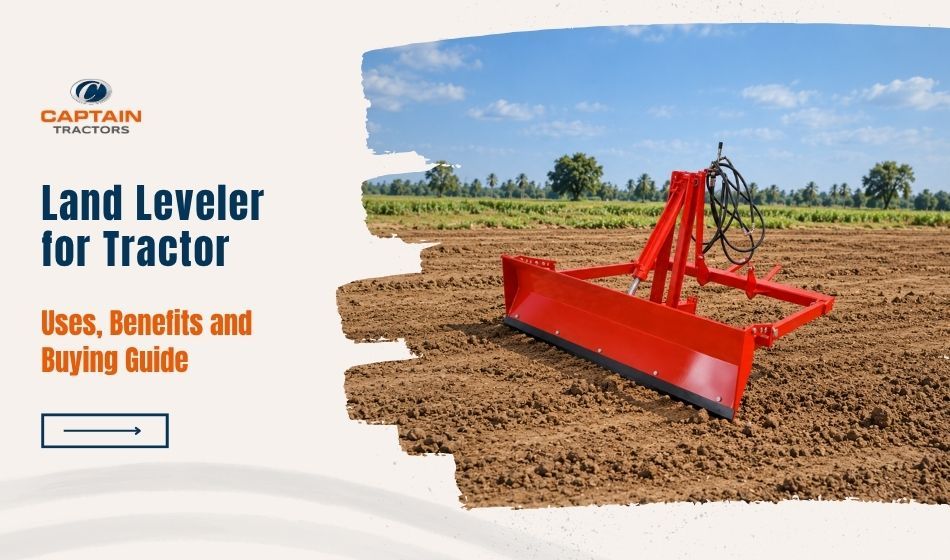
A land leveler for a tractor is a rear-mounted implement with a strong blade or scraper. As the tractor moves across the field, the blade removes soil from higher areas and spreads it into lower areas. With a few passes, the field becomes more even.
It is a simple and practical way to fix small bumps and dips that develop over time due to ploughing, sowing, and harvesting.
How Does a Tractor Land Leveler Work?
The process is straightforward and follows the same basic steps on most farms:
- Attach the leveler to the tractor's three-point linkage.
- Lower the implement to the working position you need.
- Drive across the field in straight, overlapping passes.
- The blade cuts soil from high spots as you move.
- That soil shifts and settles into the low spots nearby.
- Repeat passes over stubborn high or low areas.
- Finish once the surface is reasonably even.
You will rarely get a perfectly flat field in one pass with a land leveler for tractor use. Most farmers plan for two or three passes, more on fields that haven't been levelled in a while.
Uses of a Land Leveler for Tractor
Levelling uneven fields. This is the core job, smoothing out the rises and dips that build up over time.
Filling low spots and depressions. Areas where water tends to pool get filled in, reducing standing water after rain or irrigation.
Removing high patches. The cutting edge scrapes down raised ground so it doesn't sit above the rest of the field.
Preparing land before sowing. A more even surface supports more consistent seedbed preparation for the next crop.
Improving irrigation distribution. Water spreads more evenly across a level field instead of collecting in low corners and starving higher patches.
Maintaining farm paths. The same implement is useful for smoothing internal farm roads and pathways, not just cropped fields.
Benefits of Using a Tractor Land Leveler
A land leveler for tractor offers several practical benefits. It helps create an even field, so water spreads more evenly across the soil. This also reduces the need for manual levelling work after each season.
It makes field preparation faster and helps create a more consistent seedbed for the next farming operation. Choosing the right size of land leveler also saves time and fuel because the implement covers more area in each pass.
Types of Land Levelers for Tractors
Conventional Tractor Land Leveler: This is a basic mechanical implement used for regular field levelling, filling small low spots, and preparing the soil. It works well for most small and medium-sized farms.
Heavy-Duty Land Leveler: This type has a stronger and heavier design. It is suitable for larger fields or areas where the soil needs more levelling work.
Laser Land Leveler: This system uses a laser transmitter, receiver, and hydraulic controls to adjust the blade automatically. It provides more accurate levelling than a conventional leveler but usually needs a suitable tractor and a higher investment.
These types are not the same. A conventional land leveler works well for basic field levelling, while a laser land leveler is designed for more precise work. Choosing the right type helps you avoid unnecessary costs and get better results.
What Tractor HP Is Required for a Land Leveler?
There is no single horsepower figure that applies to every land leveler for tractor use. The rule of thumb is simple: a smaller, lighter leveler suits a smaller tractor, and a wider or heavier leveler needs more tractor power to lift and pull it properly.
Tractor Power | Typical Leveler Direction |
| 25–35 HP | Medium compact models |
| 30–45 HP | Medium to heavier models |
| 45–60 HP | Larger, heavier land levelers |
| 60+ HP | Large-scale land levelers |
Treat this as a general guide rather than a fixed compatibility chart, always confirm the exact match with your dealer before buying.
Why Choose Captain Tractors for Land Levelers
Knowing the general HP-to-leveler relationship is useful, but choosing an implement designed specifically for compact and mini tractors also matters. We build our farm implements with the needs of smaller tractors and farms in mind rather than simply scaling down equipment made for larger machines.
At Captain Tractors, we have been manufacturing compact and mini tractors and implements since 1994 from our manufacturing base in Gujarat. Our tractor range covers 12 HP to 28 HP, so we understand the requirements of smaller tractors and design our implements accordingly.
Our land levelers are built and sized to work with this compact tractor segment. With a network of 175+ dealers and exports to 80+ countries, we also provide farmers with access to service and spare parts as they continue using their equipment.
How to Choose the Right Land Leveler for Your Tractor
Check your tractor's horsepower first. This is the starting point for choosing any land leveler for tractor use, and every other decision on this list follows from it.
Match the working width. A wider blade covers more ground per pass but demands more tractor capability to pull through soil evenly.
Consider the implement's weight. Your tractor needs to lift and handle the leveler safely, not just pull it.
Check linkage compatibility. Confirm the three-point linkage category matches your tractor before you commit to a model.
Factor in soil type. Heavier soil resists the blade more, which can call for a stronger tractor than lighter soil would need.
Think about field size. Larger fields can justify a wider implement, but only if your tractor's capacity supports it.
Look at blade construction. Blade thickness, material, frame strength, and the cutting edge all affect how well the leveler holds up over repeated seasons.
Consider maintenance and spare parts. A simple, well-supported design saves you time and cost over the implement's working life.
Captain Tractors Land Leveler
Captain Tractors offers a land leveler built for routine field preparation and soil levelling. It is a rear-mounted implement designed to smooth uneven surfaces, redistribute soil, and help prepare fields before sowing.
Specification | Captain Land Leveler |
| Working Width | 1,370 mm |
| Overall Width | 1,380 mm |
| Length | 700 mm |
| Height | 800 mm |
| Approx. Weight | 73 kg |
Its practical applications include field levelling, filling low areas, removing surface irregularities, preparing land before sowing, improving field uniformity, and maintaining farm paths. Check the implement's recommended tractor compatibility with Captain Tractors directly before ordering, since the right match depends on your specific tractor model.
Land Leveler vs Laser Land Leveler
Factor | Conventional Land Leveler | Laser Land Leveler |
| Basic field levelling | Suitable | Suitable |
| Precision | Standard | Higher |
| Technology | Mechanical | Laser-guided |
| Typical cost | Generally lower | Generally higher |
| Setup | Simpler | More complex |
| Small, routine jobs | Suitable | Often more than needed |
| Precision grading | Limited | Better suited |
A conventional land leveler works well for regular field levelling and maintenance. A laser land leveler is worth the extra cost when you need highly accurate field levelling and better control of the land’s slope, especially for efficient irrigation. For everyday levelling work, a conventional leveler is usually enough.
Land Leveler vs Other Land Preparation Implements
Implement | Main Purpose |
| Land Leveler | Smooth and redistribute surface soil |
| Cultivator | Loosen and cultivate soil |
| Rotavator | Break and mix soil into a fine seedbed |
| Disc Harrow | Break clods and prepare soil |
| MB Plough | Primary soil inversion |
These implements often work together across a field preparation cycle rather than replacing one another.
Land Leveler Price in India
The price of a land leveler for tractor use varies depending on the type and features. A basic land leveler and a laser land leveler are different machines, so their prices can differ a lot.
Before comparing prices, look at a few important factors:
- Type of land leveler
- Working width
- Weight and build quality
- Tractor HP requirement
- Features and technology
A cheaper leveler is not always the better choice. Two models with different prices may also have different capabilities.
For the Captain Tractors land leveler latest price, contact our team or your nearest Captain Tractors dealer for a quote.
A Farmer's Perspective on Choosing the Right Leveler
Farmers who've bought a land leveler before will often tell you the same thing: the mistake isn't picking a bad implement, it's picking one sized for a different tractor or a different field.
If you have a compact tractor and a small or uneven field, choose a lighter and narrower land leveler. Your tractor can handle it easily, and you can level the field in fewer passes.
A wider leveler might look faster, but it can put too much load on a small tractor and may not give even results.
Choose a land leveler based on your tractor and field needs, not simply the biggest size available. The right size helps you save time, fuel, and extra trips to the field.
Common Mistakes to Avoid When Buying a Land Leveler
Buying based only on price. The cheapest land leveler for tractor use isn't always the right fit for your tractor or field.
Choosing a leveler too wide for the tractor. Your tractor needs enough power and handling capacity to use it properly.
Ignoring implement weight. The tractor must be able to lift and operate the leveler safely.
Ignoring soil conditions. Heavier soil changes the power and build requirement.
Confusing normal and laser levelers. They serve different precision needs and different budgets.
Not checking linkage compatibility. Confirm the mounting arrangement matches your tractor before you buy.
Not checking spare parts and service. Long-term support matters as much as the initial purchase for any farm implement.
How to Maintain a Tractor Land Leveler
Regular maintenance helps your land leveler work properly for longer.
- Clean the soil from the leveler after every use.
- Check the blade for wear and damage.
- Inspect the mounting points and welds regularly.
- Tighten any loose bolts and fasteners.
- Store the implement in a covered, dry place when not in use.
- Check for rust and treat it early.
- Replace worn or damaged parts before they affect performance.
A few simple checks after each use help keep your land leveler ready for the next season.
Frequently Asked Questions
Can a land leveler be used with a mini tractor? Yes, but fitting a land leveler for tractor use to a mini tractor depends on the leveler's size, weight, linkage, and your tractor's actual capability, always check these details rather than assuming any leveler will fit any tractor.
What is the difference between a land leveler and a rotavator? A land leveler smooths and redistributes existing surface soil to even out the field. A rotavator breaks and mixes soil to create a fine, loose seedbed. They solve different problems in the same field preparation process.
Can a land leveler be used after ploughing? Yes. Levelling after ploughing or other soil-working operations helps smooth the surface before the next step, such as sowing.
How wide should a tractor land leveler be? Width should match your tractor's capability and your field conditions, not simply the widest model available. A leveler that's too wide for your tractor won't perform well even if it looks like better value.
Is a laser land leveler necessary for every farm? No. Conventional levelling is enough for most routine field maintenance. A laser leveler is worth the extra cost mainly when a farm needs precise, controlled field grading for advanced irrigation management.
How often should a field be levelled? This depends on your field's condition, soil movement, tillage practices, and irrigation setup. There's no universal yearly schedule — inspect your field each season and level it when unevenness starts affecting sowing or irrigation.
Conclusion
A land leveler for tractor use is worth adding to your implement list when you need to correct uneven surfaces, move soil from high spots to low areas, and prepare a more uniform field for the next operation. The right land leveler for tractor use depends on your tractor's horsepower, the implement's weight and working width, your soil conditions, and how much precision your levelling job actually needs.
Need a land leveler for your tractor? Explore the Captain Tractors Leveler or contact the team to check the right implement for your tractor and field requirements.
Loading...