October 26, 2026
Renting vs Buying a Tractor in India: What's Better for Your Farm?
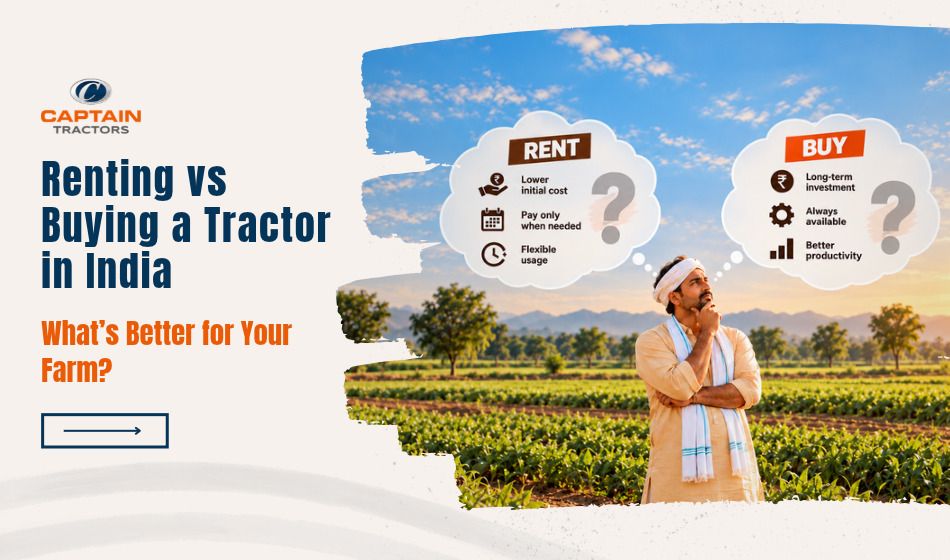
Every farmer who plans to mechanise reaches the same question. Should I rent a tractor when I need one, or should I invest in buying a tractor of my own?
Renting can be a good option if you only need a tractor during certain seasons. But if you use it regularly for ploughing, transporting crops or other farm work, buying one may be more practical.
In this guide, we will look at the costs of renting and buying a tractor, the pros and cons of both options, and what small farmers, first-time buyers and orchard owners should consider before making a choice.
Renting vs Buying a Tractor: What's the Difference?
Renting means you pay to use a tractor only when you need it. You do not own the machine, so you do not carry the full cost of keeping it.
Buying means you pay for the tractor, either in full or with a loan. After that, the tractor is yours. You also take on the cost of fuel, servicing, repairs, insurance and other expenses.
The better option depends on three things:
- How often you need a tractor
- What rental services are available near your farm
- What kind of work you do
What Does It Cost to Rent a Tractor in India?
Tractor rental cost is not the same everywhere. It changes with the place, the tractor, the implement and the season. So please do not take one rate as the rate for all of India. Ask two or three local providers and note down what each one charges.
Here is what to look at:
- Basis of charge: Some providers charge per hour, some per day and some per acre.
- Operator: Check if the operator is included or if you have to pay extra.
- Fuel: Find out if the fuel cost is in the rate or if you pay it separately.
- Transport: Some providers charge to bring the tractor to your field.
- Implement charges: A rotavator, plough or sprayer may cost extra.
- Peak season: Tractors are in high demand at sowing and harvest. You may have to wait, or pay more.
The last point matters most. The biggest problem with renting is not always the cost. It is timing. If the tractor reaches your field late, the work gets late too.
What Does It Cost to Buy and Own a Tractor?
The purchase price is only one part of the story. When you plan on buying a tractor, think about the full cost of owning it. Here is the list:
- Initial payment or down payment: The money you pay at the start.
- Loan interest and EMI: If you finance the tractor, you pay interest and regular instalments.
- Fuel: This depends on how much you use the tractor and the work it does.
- Routine servicing: Oil changes, filters and checks as per the manual.
- Repairs and spare parts: Wear and tear is normal, so keep some money aside.
- Insurance and registration: Check what applies to your tractor.
- Implements and attachments: A tractor needs implements to do the work.
- Depreciation: The tractor loses some value as it gets older.
Many farmers count only the price and the EMI. Then they get surprised by the other costs. A fair tractor ownership cost always includes all of the above.
Renting vs Buying a Tractor: Cost Comparison
Factor | Renting a tractor | Buying a tractor |
| Initial expense | Usually lower | Higher |
| Payment pattern | Pay when needed | Purchase payment or regular EMIs |
| Maintenance | Usually handled by the provider, subject to the agreement | Owner's responsibility |
| Availability | Depends on local supply | Available when maintained and working |
| Choice of implements | Depends on the provider | Owner can select compatible implements |
| Frequent farm work | Repeated rental costs can add up | May be more economical with regular use |
| Infrequent farm work | Can be more practical | The tractor may sit idle |
When Is Renting a Tractor Better?
Renting can be the better choice in these cases:
- You need a tractor for only a few operations each season.
- Buying would put a heavy load on your cash.
- You need special machinery only once in a while.
- Reliable rental services are available close by.
- You do not want to manage maintenance and repairs.
Renting is not always cheaper, and it is not always costlier. If you rarely use a tractor, renting is often the more practical way. That is the honest picture.
When Does Buying a Tractor Make More Sense?
Buying a tractor may be worth considering in these cases:
- You need a tractor regularly through the year.
- You grow more than one crop, so you repeat field work often.
- Timely work matters, because your sowing or cultivation window is short.
- You want to decide when and how the tractor is used.
- One tractor can do many jobs with the right implements.
- Rental services near you are unreliable or expensive.
A pattern we often see: A farmer rents a tractor for years. Each season he waits for his turn, and each season the sowing gets a few days late. After a few seasons, he starts to feel that the delay costs him more than the rent. That is usually the point when a farmer starts thinking seriously about buying a tractor. The farmers who decide well are the ones who first sit down and write the numbers.
How to Calculate Whether Buying a Tractor Is Worth It
You do not need special software. A pen and paper are enough. Work out two numbers for one year.
Annual rental cost
Rental charge per operation × number of operations in a year. Then add any fuel, transport or operator charges that are not in the rate.
Annual ownership cost
Loan interest or financing cost + fuel + maintenance and repairs + insurance and other expenses. For a fuller picture, also add depreciation and the cost of the money you have invested.
If you are paying cash, do not count the full price as one year's cost. Spread it across the years you expect to use the tractor.
A Simple Worked Example
The numbers below are only to show the method. They are not real rates. Replace them with your own local rental rates, fuel costs and quotations.
Item | Illustrative figure (units) |
| Cost of one rented operation, including extra charges | 10 |
| Operations per year | 12 |
| Annual rental cost | 120 |
| Yearly financing cost | 50 |
| Yearly fuel | 20 |
| Yearly servicing and repairs | 15 |
| Yearly insurance and other costs | 5 |
| Yearly depreciation | 20 |
| Annual ownership cost | 110 |
In this made-up case, ownership comes out a little lower. But change the operations from 12 to 5, and renting would be about 50. Then renting wins easily. This is why usage matters more than any rule of thumb.
Also remember what the numbers cannot show. Owning gives you timing and control. Renting gives you freedom from repairs. Give some weight to both.
Should Small Farmers Buy a Mini Tractor or Rent One?
Small farms often feel stuck here. A big tractor is too much, but a rented tractor may not come on time. A compact tractor can help in some cases, such as smaller farms, orchards and narrow rows. But it still depends on your actual workload and field conditions.
Think about these points:
- Farm size and field layout: Small, narrow or uneven plots suit a compact tractor.
- Crop type: Orchards and vegetable crops need a tractor that turns easily.
- Hours of use per year: More hours make ownership easier to justify.
- Horsepower needed: Check what your implements need.
- 2WD or 4WD: 4WD helps on soft or wet ground.
- Implement compatibility: Make sure the tractor works with the implements you plan to use.
- Budget and maintenance: Can you afford the down payment, the EMI and regular care?
Captain Tractors has been manufacturing compact and mini tractors in Gujarat since 1994. Our tractors are used by farmers across India for work on small and medium-sized farms and in orchards. With 175+ dealers across our network and customers in more than 80 countries, we offer models ranging from 12 HP to 28 HP, including options to suit different crops, field sizes and farming needs.
If your farm is small, the Captain Little Master 120 is a lightweight 12 HP tractor worth a look. If you need more power for heavier work, see the Captain 200 DI.
A tractor works through its implements. Our tractor implements include rotavators, cultivators, ploughs and more. Add their cost to your plan, and check that they suit the tractor you pick.
How to Choose the Right Tractor Before Buying
Use this checklist before you decide:
- List your operations. Write down every job you want the tractor to do.
- Estimate your usage. How many times a year will you use it?
- Check horsepower. Make sure it matches your implements.
- Compare costs. Put the yearly rental cost next to the yearly ownership cost.
- Plan your finances. Decide what down payment and EMI you can pay without stress.
- Check service and spares. Is there a dealer or workshop near you?
- Compare models. Look at two or three compatible tractors before you choose.
If you are thinking of financing, ask the lender for the full repayment schedule and the total amount payable in writing.
FAQs About Renting vs Buying a Tractor
Is it better to rent or buy a tractor in India?
It depends on your use. If you need a tractor only a few times a year and rentals are easy to get, renting may be better. If you need one often and on time, buying a tractor may give better value over the years.
When should a farmer consider buying a tractor?
Think about buying when you use a tractor regularly, grow more than one crop, need timely work, or cannot depend on local rentals. Check your numbers first.
Is buying a tractor worth it for a small farm?
It can be, if you use the tractor often enough and it fits your fields. A compact tractor may suit a small farm or an orchard. If your work is limited, renting may still make more sense.
What costs should farmers consider before buying a tractor?
Count the down payment, loan interest and EMI, fuel, servicing, repairs, insurance, registration, implements and depreciation. The tractor ownership cost is more than the price.
Is renting a tractor cheaper than owning one?
Not always. For a few jobs a year, renting is often cheaper. For many jobs through the year, repeated rent can add up and ownership may cost less. Compare with your own numbers.
How can farmers calculate the cost of owning a tractor?
Add up the yearly cost of financing, fuel, servicing, repairs, insurance and depreciation. If you pay in cash, spread the price over the years you plan to use the tractor. Then compare that total with your yearly rental cost.
Should farmers buy a mini tractor or rent a larger tractor?
If your fields are small, narrow or in an orchard, a mini tractor may do the job well and cost less to run. For heavy work on a large area, a larger tractor on rent may be more practical. Match the tractor to your actual work.
Make the Decision With Your Own Numbers
Renting and buying a tractor are both valid choices. Renting suits occasional work. Buying suits regular work where timing matters. If you are not sure, work out the yearly costs, and decide only when you can afford the full cost of owning it.
If you decide that ownership suits your farm, visit Captain Tractors to see the range and find your nearest dealer.
Loading...