August 26, 2026
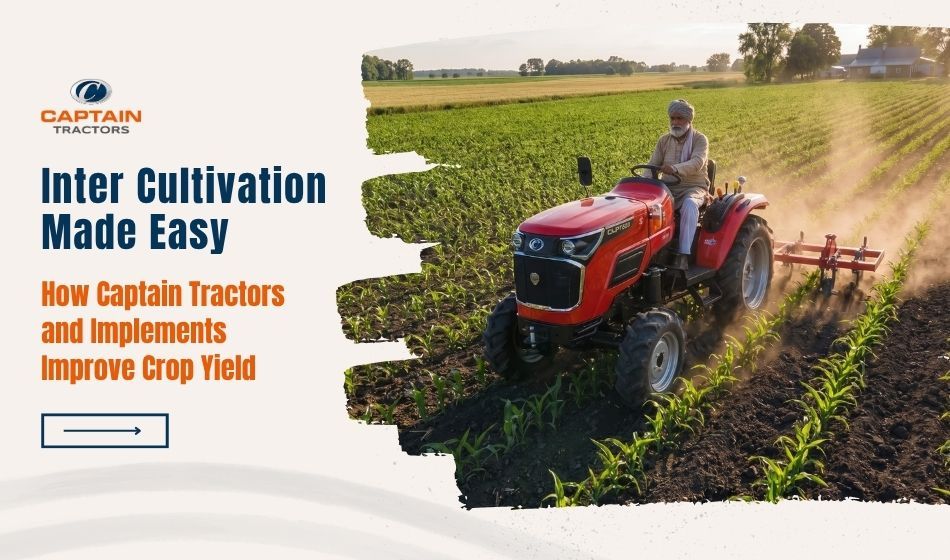
Inter Cultivation Made Easy: How Captain Tractors and Implements Improve Crop Yield
Weeds start growing the same day your crop does, sometimes even before. And they don't ask for permission — they pull at the same water, the same soil, and once they get tall enough, they start blocking sunlight too.
If those weeds aren't cleared early, and the soil between the rows is left hard, the crop feels it. Roots stay weak. The ground dries out faster than it should. And by the time harvest comes around, you can usually tell which fields got timely attention and which didn't.
This is really why inter cultivation matters so much. It controls weeds, loosens the soil, and gives the crop a better chance to grow properly. But doing this by hand takes a lot of time, and a lot of people too. When labour runs short or the work gets pushed back a week, weeds spread fast, and the crop pays for it.
A tractor with the right implement changes this. It covers more land in less time, needs fewer hands, and leaves the crop in better shape through the season. So this guide gets into what inter cultivation actually means, why it affects yield more than people give it credit for, and how the right equipment turns a slow, tiring job into a quick one.
What is Inter Cultivation?
Inter cultivation is the work of cleaning and loosening the soil between the rows while the crop is actively growing. Inter cultivation happens after the crop is already in the ground, not before.
Here's the thing about weeds left between rows: they're not just sitting there looking untidy. They're pulling water and nutrients away from the crop, quietly, the whole time. Leave them a few weeks too long, and the crop has already lost ground it won't fully make up later. Inter cultivation clears this out early. It loosens the soil so air and water actually reach the roots instead of staying stuck on top of a hard, dry crust.
Farmers have used hoes for this work for generations, and on a small plot, honestly, a hoe still does the job fine. On a bigger farm though, it starts eating up days, and needs more hands than most farms can spare during the busy weeks. A tractor with the right implement covers the same ground much faster — and more evenly too, since tired hands by the fourth hour of hoeing rarely match the first hour's work.
Cotton, maize, sugarcane, soybean, groundnut, vegetables, orchard crops — most of these need this kind of care at some point in the season. Time it right, and the field stays clean straight through, instead of turning into a weed problem you're constantly chasing later.
Why Inter Cultivation Matters for Crop Yield
People tend to think of this as just weeding. It's more than that, really. Clearing weeds is only one part of what's happening underground.
Weed control: Weed control is the obvious piece. Clear the weeds regularly, and the crop gets its proper share of water, light, and nutrients instead of splitting everything with plants nobody wanted there in the first place.
Better soil aeration: Soil aeration improves too, and this one matters more than farmers sometimes realise. Watering, foot traffic, machines rolling through — all of it packs the soil down over a season. Loosen it back up, and air gets to the roots again. Roots that get air tend to dig deeper and hold the plant steadier in dry weeks.
Moisture conservation: Moisture sticks around longer in loosened soil. A hard, crusted surface loses water to the sun fast. Break that crust, and the ground holds onto moisture noticeably longer, which counts for a lot once the hot weeks set in.
Improved nutrient availability: Fertilisers work better when they reach the root zone. Inter cultivation mixes the topsoil, making it easier for nutrients to move closer to the roots.
Stronger root growth: Roots grow more freely in loose soil than in hard, compacted ground. Strong roots absorb water and nutrients more efficiently, helping crops grow healthier.
Lower pest and disease risk: Pest problems tend to drop as well, since weeds usually give insects somewhere to hide and multiply. Clear the field out, and there's less cover, plus better airflow around the crop besides.
When all these benefits come together, crops grow stronger from the early stages until harvest. Healthy roots, fewer weeds, better moisture, and improved nutrient uptake all contribute to better crop growth and higher productivity.
Which Crops Need Inter Cultivation
Most row-planted crops need this at some stage. How often depends on the crop itself, and honestly, on how fast weeds come back in your particular soil.
Cotton, sugarcane, maize, soybean, groundnut, turmeric, chilli, plenty of vegetables — all of these respond well to regular inter cultivation. Orchards need it too. Keep the ground loose and clean around the tree rows, and it shows up later, in the fruit.
Row spacing changes how the work gets done, though it doesn't change whether the work is needed. Cotton and sugarcane leave wider gaps to move through. Vegetables, planted tighter together, need a smaller tractor that turns easily — one that can slip between narrow rows without brushing against the crop on either side.
The Challenge of Doing It by Hand
Talk to almost any farmer who's cleared a full field by hand, and the same complaint comes up. Finding enough people is the hard part — not the actual work.
During the busy weeks, labour is scarce, plain and simple. Even when workers are around, paying for repeated rounds of weeding adds up over a season more than people expect. And manual weeding is slow enough that by the time one end of the field is finished, weeds are already creeping back where the work started.
There's a consistency problem too. Some workers weed carefully, others move fast and skip patches, so you end up with a field that's clean here and still weedy there. A careless hoe stroke can also nick a stem or clip a shallow root, which more or less undoes the whole point of doing the work in the first place.
Delay this because labour wasn't around, and weeds get ahead in a way that's hard to claw back later in the season. A tractor with the right implement sidesteps most of this trouble. It finishes on time, treats the whole field the same way, and doesn't depend on how many workers happened to show up that particular week.
How the Right Tractor Makes Inter Cultivation Easier
This work happens between crop rows, so the tractor needs to be compact and easy to handle — something that can move through narrow spaces without clipping the crop on either side.
Captain Tractors are built with exactly this kind of work in mind. The compact size and tight turning radius make it a lot easier to move between crop rows, through orchards, and across vegetable fields. Turning cleanly at the end of a row without wasting space matters more here than most people expect until they've actually tried it.
Running costs matter too, since this work often needs doing more than once a season. A fuel-efficient engine keeps that repeated cost from piling up, and a tractor that spends less time in for repairs stays out working exactly when timing matters most.
Visibility for the operator plays a bigger role than it sounds like it should. Being able to clearly see the crop row and the implement attached behind you helps avoid damaging the plants by accident. Cotton fields, sugarcane farms, vegetable plots, orchards — whatever the setting, a compact tractor generally gives better control, and that makes the whole job faster and safer.
Implements That Support Inter Cultivation
The tractor gets you into the field. The implement attached behind it is what actually works the soil, and picking the right one changes the outcome more than people realise.
Cultivator
A cultivator is one of the most commonly used implements for inter cultivation. It loosens the soil between crop rows and removes weeds without disturbing the standing crop. It handles a wide range of soil types reasonably well, which is part of why it's such a common choice.
Blade Cultivator
A blade cultivator is designed for shallow soil cultivation and weed control between crop rows. Its blades cut through weeds while loosening the top layer of soil. It is useful for farmers who need regular inter-cultivation without deep soil disturbance.
Spring Tyne Cultivator
A spring tyne cultivator uses flexible spring-loaded tynes to loosen soil and control weeds. The tynes provide better flexibility when working through uneven or harder soil conditions. It is suitable for inter-cultivation and general field preparation.
Ridger
A ridger is useful for crops that require raised beds or well-defined furrows, such as potatoes, sugarcane, and vegetables. It helps improve irrigation, drainage, and root development while also controlling weeds between the rows.
Rotavator
Although a rotavator is mainly used for land preparation before sowing, it is also helpful for soil management between cropping seasons. It breaks up hard soil, mixes crop residue, and prepares the field for the next crop.
Paddy farmers often pair cage wheels with the tractor for better grip once the soil turns soft and wet. Some farms bring in smaller weeding or mulching attachments too, depending on the crop and how heavy the weed growth is. What actually suits your field, though, is worth a real conversation with your local dealer, rather than a guess.
Benefits of Using the Right Implements
Get the implement right, paired with a tractor that suits your field, and inter cultivation stops being the job everyone keeps putting off.
Coverage speeds up the most, and by a fair margin. Days of hand work often becomes a single pass with the right implement behind the tractor.
Results also come out more even, since a machine holds a steady depth across the whole row — something tired hands with a hoe rarely manage by the end of a long day.
Labour dependence drops sharply, which matters most in exactly the weeks when workers are hardest to find in the first place.
Running costs stay reasonable too, especially with a fuel-efficient tractor and an implement that's actually matched to the job, rather than whatever happened to be available.
And crop damage becomes less likely as well, since careful movement between rows means fewer nicked stems and clipped roots while the weeds get cleared.
Choosing the Right Tractor for Inter Cultivation
There's no single "best" tractor for this. It comes down to your farm, your crop, and how your rows are spaced.
Farm size matters first. Small and medium farms generally do better with a compact tractor — easier to turn, easier to live with day to day, and better suited to work that repeats several times across a season.
Crop type and row spacing come next. Cotton and sugarcane give more room to move through. Vegetables and orchard rows want tighter control, and that's exactly where a smaller turning radius pays off.
PTO power is worth checking too — whatever implement you're running, cultivator, ridger, rotavator, sprayer, make sure the tractor actually has enough power to drive it properly.
Hydraulic lifting capacity matters as well. Weak hydraulics tend to show up fast as jerky, uneven work out in the field.
And field conditions round things out. Soft soil, uneven ground, orchard rows — each wants slightly different handling, so it helps to match the tractor to your actual land rather than just a spec sheet on paper.
Captain's compact range, including the 200 DI 2WD, 200 LS 4WD and 250 DI 4WD, was built around exactly this kind of work — small and medium farms, orchard rows, row-crop fields where getting around matters more than raw size.
Captain Tractor vs Large Conventional Tractors for Inter Cultivation
Neither type wins outright. It really depends on what your farm needs most.
Feature | Captain Tractor | Large Tractor |
| Farm Suitability | Small & medium farms | Large farms |
| Turning Radius | Tight | Wide |
| Row Crop Farming | Well suited | More limited |
| Fuel Consumption | Lower | Higher |
| Orchard Use | Ideal | Difficult |
| Ease of Operation | Easy | Moderate |
| Implement Compatibility | Wide range | Wide range |
| Maintenance | Lower | Higher |
Compact tractors tend to come out ahead for inter cultivation and orchard work, mostly down to size and turning radius. Large tractors still hold their ground on bigger, open land doing heavier jobs. Pick based on what your land actually calls for.
Maintenance Tips for Inter Cultivation Equipment
A little regular care keeps implements running well for a lot longer.
- Lubricate moving parts before and after heavy use.
- Check and tighten bolts that work loose from field vibration.
- Look over blades and tines for wear, and swap them before they get too blunt to cut cleanly.
- Check hydraulic connections for leaks or weak pressure.
- Keep tyre pressure at the right level for stable, even movement.
- Clean the equipment after use — soil and residue build up faster than most people expect.
- Stick to a regular service schedule instead of waiting for something to break mid-season.
Safety Tips During Inter Cultivation
A few habits, followed consistently, prevent most of the problems that come up in the field.
Keep the tractor at a steady, sensible speed, since rushing between rows is usually how crops end up damaged. Check the tractor and implement over before starting work, every single time, not just when something feels off. Stay out of waterlogged or very wet fields, where grip goes unreliable fast. Keep the tractor properly aligned with the rows through the whole pass. Wear the right safety gear while operating machinery, and follow the manufacturer's guidelines for whatever implement is attached that day.
Why Captain Tractors Suit Small and Medium Farms
Captain Tractors builds compact tractors around what small and medium farms actually need day to day — not a big tractor scaled down, but something designed for this kind of work from the ground up. Reliable, reasonable on fuel, easy enough to manage through tight rows without a fight.
As a tractor manufacturer working across India, Captain builds machines that pair with a wide range of implements, so one tractor can genuinely handle land preparation, inter cultivation, spraying, and transport instead of needing a separate machine for each job. Add in easier maintenance and a dealer and service network that keeps growing, and the goal has stayed pretty much the same throughout: equipment that keeps working, season after season, without much drama.
Conclusion
Inter cultivation isn't something you can skip and not pay for later, one way or another. Done at the right time, it saves the crop a fight it shouldn't have to have — clean rows, loose soil, and a real shot at a strong harvest by the end of it.
Pair a compact tractor with the right implement, and this stops being the chore everyone dreads. It becomes one of the more manageable jobs on the calendar, honestly. Take a look at Captain Tractors' range of mini and compact tractors and implements to find what actually fits your field.
Frequently Asked Questions
What is inter cultivation in agriculture? It's the work of loosening and cleaning the soil between crop rows after sowing, mainly to clear weeds and let air and water reach the roots.
Which tractor is best for inter cultivation? Generally a compact tractor with a tight turning radius, since it can move between narrow rows without damaging the crop on either side.
Can a mini tractor be used for inter cultivation? Yes, and it's often the better fit — the smaller size makes it easier to work close to the rows than a bigger tractor can manage.
Which Captain Tractor is suitable for row crop farming? Models like the 200 DI 2WD and 280 DX 2WD, built with the compact size and easy handling that row crop and orchard work usually call for.
Can one tractor handle multiple farm implements? Yes. A single compact tractor can typically run several different implements across a season, which is part of why farmers lean toward one versatile tractor rather than buying separate machines for each job.
Is a compact tractor suitable for orchard farming? Yes — the narrower profile and tighter turning radius make it easier to move between tree rows without catching branches or roots.
What is the difference between manual and mechanized inter cultivation? Manual work depends on hand tools and labour, so it's slower and less even. Mechanized inter cultivation uses a tractor and implement to cover the same ground faster, and more evenly too.
How do I choose the right implement for my crop? It comes down to row spacing, soil type, and the crop itself, so it's worth talking to your local dealer about what actually fits your field rather than guessing.
Loading...