September 30, 2026
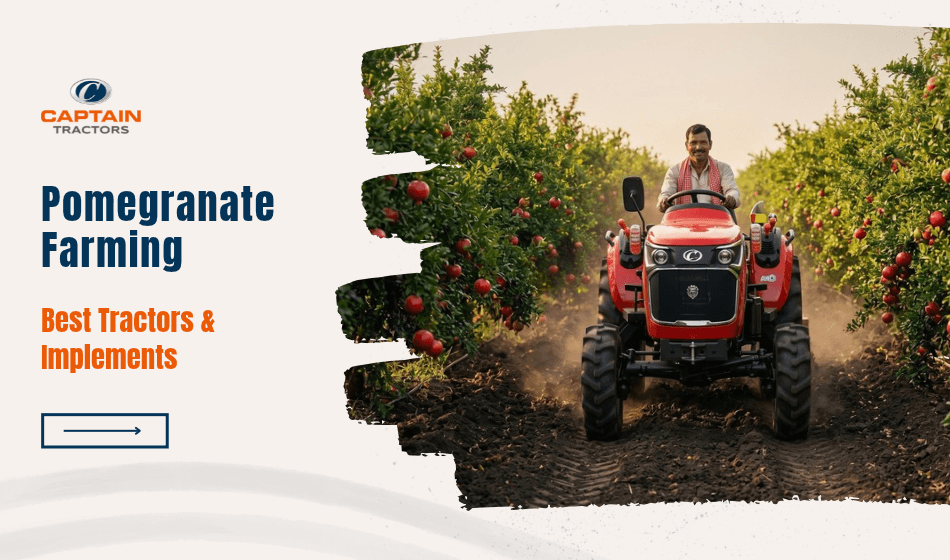
Best Tractors & Implements for Pomegranate Farming
Pomegranate farming involves a lot of work between narrow rows. You need to manage weeds, cultivate the soil, spray crops, and move fruits and farm inputs around the orchard. Since you work close to trees, irrigation lines, and support structures, choosing the right tractor is important.
The best tractor for pomegranate farming is not always the one with the highest horsepower. You need a tractor that fits easily between your rows, has enough power for your implements, and works well with your soil and land conditions. This guide explains what to look for in a tractor and the right implements for your pomegranate orchard, helping you choose the best option for your farm.
Why Do You Need a Tractor for Pomegranate Farming?
Most of the recurring work in a pomegranate orchard is mechanised in some form, and each task points to a slightly different tractor or implement requirement.
Soil preparation ahead of planting or a new season relies on a rotavator or cultivator to break and prepare the ground.
Inter-cultivation between rows keeps soil loose and manages weeds without disturbing plant roots too close to the trunk.
Weed management often uses the same inter-row implements as cultivation, timed to when weeds are actively competing with the trees.
Spraying for crop protection is one of the most frequent orchard operations, and it needs a tractor that can carry a sprayer through rows without damaging branches.
Fertiliser and input application is easier and faster with the right tractor-mounted attachment instead of manual spreading.
Farm transport — moving fertiliser, spray tanks, harvested fruit, and general farm materials — is routine enough that a trailer earns its place on most orchards.
What Makes a Tractor Suitable for Pomegranate Farming?
Several traits together decide what makes the best tractor for pomegranate farming, not any single specification on its own.
Compact size. A narrower tractor moves through rows without brushing against branches or irrigation lines — a key trait of the best tractor for pomegranate farming.
Easy maneuverability. Tight turning at row ends matters as much as raw power in an orchard layout.
Suitable horsepower. Enough power for your implements, without paying for capacity you'll never use.
2WD or 4WD. The right choice depends on your terrain and soil, not a fixed rule.
Ground clearance. Useful for moving through the orchard without catching on soil beds or irrigation fittings.
PTO compatibility. Your PTO needs to match the implements you plan to run, especially sprayers and rotavators.
Hydraulic performance. Stronger hydraulics give you more consistent implement control across different tasks.
Implement compatibility. The tractor and implement need to work together, not just individually meet a spec sheet.
Fuel and maintenance costs. Orchard work is repetitive, so day-to-day running costs matter over the tractor's working life.
What HP Tractor is Best for Pomegranate Farming?
There's no single horsepower number that fits every pomegranate orchard, and the search for the best tractor for pomegranate farming shouldn't start with a fixed HP figure.
A 20–30 HP compact tractor is worth considering for most orchard operations, but the right figure for your farm depends on row spacing, soil, terrain, and the implements you plan to run.
Tractor Range | Suitable Direction |
| 12–15 HP | Light-duty compact orchard work |
| 18–22 HP | Small orchard and routine operations |
| 24–28 HP | More demanding orchard operations |
| 30+ HP | Heavier implements and larger workload |
Use this as a general guide, not a fixed rule. A 20 HP tractor with the right implements might work well for one orchard, while another orchard nearby might need more power because of different row spacing or soil conditions.
Choosing Captain Tractors for Your Pomegranate Farm
Once you know how much horsepower you need and which farm operations you want to handle, the next step is choosing the right tractor. At Captain Tractors, we have focused on compact and mini tractors since 1994, designing machines for the needs of farmers working in smaller fields, orchards, and narrow spaces.
Our tractor range covers 12 HP to 28 HP, giving pomegranate farmers options for different orchard sizes and farming needs. Our compact tractor designs help farmers work between rows while handling tasks such as inter-cultivation, spraying, weed management, and material transport.
With 175+ dealers and an export presence in 80+ countries, we also work to keep our tractors, service, and spare parts accessible to farmers. For pomegranate farming, where tractors are used regularly throughout the season, easy access to support is an important part of choosing the right machine.
Best Captain Tractors for Pomegranate Farming
Captain's 20 HP range gives orchard farmers three configurations to weigh against their own row spacing and soil conditions when narrowing down the best tractor for pomegranate farming.
The Captain 200 DI 2WD runs a 20 HP, 895 cc water-cooled engine with a Smart ADDC hydraulic system. Its compact 2WD build suits orchards where the ground is reasonably firm and the priority is a straightforward, maneuverable tractor for routine row work.
The Captain 200 DI LS 2WD steps up to a 947.4 cc water-cooled engine with ADDC hydraulics and a multi-speed PTO, still at 20 HP and 2WD. The multi-speed PTO gives it more flexibility across implements like sprayers and rotavators, useful for orchards running a wider mix of operations.
The Captain 200 DI LS 4WD carries the same 947.4 cc engine but adds 4WD, which is worth considering where your orchard's terrain or soil makes extra traction genuinely useful rather than just a nice-to-have.
None of these is automatically "the best tractor for pomegranate farming" on its own — the right one depends on your row spacing, soil, and the implements you'll actually run behind it.
Best Tractor Implements for Pomegranate Farming
Pairing the best tractor for pomegranate farming with the right farming implements is what actually determines the work it can do in your orchard.
Implement | Main Use in Pomegranate Farming |
| Cultivator | Inter-cultivation and soil loosening between rows |
| Rotavator | Soil preparation and seedbed work |
| Sprayer | Crop protection spraying |
| Ridger | Ridge or furrow work where your orchard layout needs it |
| Trailer | Transporting inputs and harvested produce |
For inter-cultivation between pomegranate rows, a suitable cultivator helps loosen the soil and control weeds without disturbing the plants.
For seedbed preparation, a rotavator breaks and mixes the soil in a single pass.
For spraying, a tractor-mounted sprayer pump helps cover the rows more evenly and saves time compared with manual spraying.
A ridger is useful when your orchard needs defined ridges or furrows for better water management.
For transporting fertiliser, spray tanks, harvested fruit, and other materials, a trailer makes routine farm work easier.
How to Choose Implements for a Pomegranate Orchard
Match the implement with tractor HP. An implement sized for a bigger tractor won't perform well on a smaller one, and vice versa.
Check working width. It needs to fit your row spacing with enough clearance to avoid damaging plants.
Consider row spacing. This is the single biggest constraint on implement choice in an orchard.
Check PTO requirements. Confirm the implement's PTO needs match what your tractor delivers.
Check hydraulic requirements. Some implements depend more heavily on hydraulic capacity than others.
Consider soil conditions. Heavier or more compact soil changes what the implement and tractor need to handle comfortably.
Avoid oversized implements. A wider or heavier implement than your tractor and rows can handle reduces efficiency and makes maneuvering harder, even if it looks like better value on paper — sizing correctly matters more than raw coverage when you're weighing the best tractor for pomegranate farming against its implement set.
Tractor for Pomegranate Orchard: What About Row Spacing?
Row spacing is an important factor when choosing the best tractor for pomegranate farming. Start by measuring the distance between your rows. Then, check the tractor’s width to make sure it fits comfortably without touching the branches.
Also consider how wide the tree canopy will become as the plants grow. Make sure there is enough space to turn the tractor at the end of each row. Check for irrigation pipes and other fixed obstacles too.
There is no single row spacing that works for every pomegranate orchard. Choose a tractor based on the actual layout and space available in your orchard.
2WD vs 4WD Tractor for Pomegranate Farming
Factor | 2WD | 4WD |
| Flat, firm orchard | Suitable | Suitable |
| Traction demand | Moderate | Higher |
| Uneven terrain | Depends on conditions | Advantage |
| Wet soil | Depends | Useful |
| Routine orchard work | Suitable | Suitable |
| Initial cost | Usually lower | Usually higher |
Choose 2WD if your orchard has firm soil and fairly level ground. Choose 4WD if your soil or terrain needs extra traction.
Do not choose 4WD simply because it sounds like the safer option. Think about your actual field conditions, row layout, and the work you need to do.
For a detailed comparison, read our guide on 2WD vs 4WD tractors to see which option fits your farm.
Mini Tractor vs Large Tractor for Pomegranate Farming
Factor | Mini/Compact Tractor | Large Tractor |
| Narrow orchard rows | Better suited | Depends on width |
| Maneuverability | Easier | More difficult in tight spaces |
| Small farms | Practical | Often excessive |
| Light implements | Suitable | Suitable |
| Heavy implements | Limited | Better |
| Orchard operations | Strong fit | Depends on dimensions |
For most pomegranate orchards, a compact tractor is a better choice because it is easier to move between narrow rows. A larger tractor is useful only when you need extra power for heavy implements. This makes compact tractors a practical choice for smaller orchards with limited space.
What a Pomegranate Farmer Learns Choosing a Tractor
Farmers who use tractors in pomegranate orchards often learn the same lesson: the tractor with the most power is not always the best choice.
If your orchard has narrow rows, a compact tractor is often easier to use. It turns more easily and moves between rows without damaging plants.
The best tractor for Pomegranate farming is the one that matches your row spacing, soil, terrain, and farm work. Choosing based only on horsepower can lead to problems later.
Common Mistakes When Choosing a Tractor for Pomegranate Farming
Buyers looking for the best tractor for pomegranate farming run into a similar set of problems again and again. Avoid these common mistakes:
- Not checking tractor width: Make sure the tractor fits comfortably between your orchard rows.
- Choosing the biggest tractor: A larger tractor is not always better. It might be difficult to turn and move through narrow rows.
- Ignoring row spacing: Measure the distance between rows before choosing your tractor.
- Choosing oversized implements: Match the implement size with your tractor and orchard requirements.
- Ignoring PTO and hydraulic needs: Check whether your tractor has enough PTO power and hydraulic capacity for your implements.
- Choosing 4WD without a need: Choose 4WD when your soil or terrain requires extra traction. Otherwise, 2WD might be enough.
- Focusing only on price: Consider fuel, maintenance, implements, and other running costs before making a decision.
- Skipping service support: Check whether dealers, spare parts, and service support are easily available in your area.
How Much Does a Tractor and Implement Setup Cost?
The total cost of a tractor and implement setup is more than the tractor’s purchase price. It also includes:
- Implements you need for your orchard
- Registration and insurance
- Accessories
- Loan or financing costs
- Maintenance and servicing
- Fuel and other running costs
The total cost depends on the tractor and implements you choose. Before buying, discuss your complete requirements with your dealer instead of looking only at the upfront price.
How to Choose the Best Tractor and Implements for Your Pomegranate Farm
Follow these steps to find the best tractor for pomegranate farming for your orchard:
- Measure your row spacing: Check how much space you have between the rows.
- List your farm work: Note the tasks you do regularly, such as cultivation, spraying, and transport.
- Choose the right implements: Select the implements you need for these tasks.
- Estimate the HP you need: Choose a tractor with enough power to handle your implements.
- Check tractor size: Make sure the tractor fits between your rows and has enough space to turn.
- Choose 2WD or 4WD: Select 4WD if your soil or terrain needs extra traction. Otherwise, 2WD might be enough.
- Check PTO and hydraulics: Make sure the tractor can handle your chosen implements.
- Check service support: Look for dealers, spare parts, and service support near your farm.
- Calculate the total cost: Include the tractor, implements, fuel, maintenance, insurance, and other costs.
Finally, share these details with your dealer and ask for a tractor and implement combination suited to your orchard.
Frequently Asked Questions
Can a 20 HP tractor be used in a pomegranate orchard? Yes, a 20 HP tractor suits many pomegranate orchards and is often cited as the best tractor for pomegranate farming on smaller landholdings, especially for routine inter-cultivation, spraying, and transport. Whether it's the right fit for your farm still depends on your row spacing, soil, and implement needs.
How do I measure orchard row spacing before buying a tractor? Measure the actual distance between your plant rows at their narrowest point, then compare that against the tractor's width plus enough clearance to operate without brushing branches or irrigation lines.
Can a mini tractor operate a sprayer in a pomegranate orchard? Yes, provided the tractor's PTO and hydraulic capacity match the sprayer's requirements. A compact tractor is often a good fit here since it can move through rows without damaging plants.
What is the difference between a cultivator and rotavator for pomegranate farming? A cultivator loosens soil and manages weeds between rows without disturbing plant roots too aggressively. A rotavator breaks and mixes soil more thoroughly, which suits seedbed preparation rather than routine inter-row maintenance. Both are common companions to the best tractor for pomegranate farming, just for different jobs.
Is 4WD necessary for a pomegranate orchard? Not always. 4WD is worth the extra cost where terrain or soil genuinely demands more traction. Many orchards with firm, manageable ground do well with 2WD.
Should I buy the tractor and implements together? It often makes sense to plan them together, since implement compatibility depends on the tractor's PTO, hydraulics, and power. Working out your full implement list before finalising the tractor helps you avoid buying a configuration that limits your options later.
Conclusion
The best tractor for pomegranate farming isn't necessarily the one with the highest horsepower. It's the tractor that fits between your orchard rows, provides enough power for your required implements, and handles your soil and field conditions comfortably. Once you know your row spacing, terrain, and the operations you need covered, the choice between models — and between 2WD and 4WD — becomes far more straightforward.
Looking for a tractor for your pomegranate orchard? Explore Captain Tractors' compact tractor range and compare models based on your row spacing, farm operations, field conditions, and implement requirements.
Ready to mechanise your pomegranate farm? Explore Captain Tractors' tractors and implements or contact the team to find a combination suited to your orchard operations.
Loading...